


Page 243 - Demo
P. 243
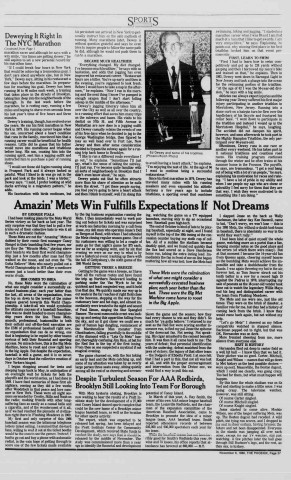
g PORTgDeweying It Right InThe NYC MarathonContinued from Page 1marathon races and although he savs with a wry smile, %u201cmy times: are getting slower,%u201d hestill aspires to set a new personal record forhis marathon time.%u201c If I could break four hours in New Yorkthat would be achieving a tremendous goal. Idon%u2019t care about anywhere else, but in NewYork,%u201d Dewey says, sitting in his restaurant afew days before the marathon. In preparation for reaching his goal, Dewey has beenrunning 50 to 60 miles each week, a trainingthat takes place in the streets of Brooklyn,taking him deep into the neighborhoods of theborough. In the last week before themarathon, he is resting easy, running a fewmiles and hoping to shave even seconds fromhis last y ear%u2019s time of five hours and threeminutes.Dewey%u2019s training, though, has evolved overthe years. He ran his first marathon in NewYork in 1979. His running career began whenhis son, concerned about a heart conditionthat runs in the family, convinced him that arunning career would be beneficial for healthreasons. Little did he guess that his fatherwould move into marathons and triathlonsbefore long. His son, coaxing him into therunning spirit, sent him a jogging outfit andinstructed him to purchase a pair of runningshoes.%u201c I would see these old fogies running alongin Prospect Park and it always looked sopainful. What I liked to do was go out in thepark and look at the birds. I was a birder,%u201dDewey says. %u201cI said, I prefer looking at wildducks arriving in a migratory pattern,%u201d headds.His fascination with birds continues, buthis persistent son arrived in New York to personally instruct him on the safe methods of running. Many marathons later, Dewey is without question grateful and says he even tries to inspire people to follow the same path he did, although he would not push them to run in a marathon.BECAME MUCH HEALTHIER%u201cEverything changed. My diet changed.I%u2019ve become much healthier,%u201d he says with nohesitation, and adds that jogging has evenimproved his restaurant career. %u201c Restauranthours are a killer. You%u2019re up early and then inthe evening, you%u2019re supposed to look fresh.Before I would have to take a nap in the afternoon,%u201d he explains. %u201cNow I run in the morning and the next thing I know I%u2019ve pumped inenough oxygen that I don%u2019t start fallingasleep in the middle of the afternoon.%u201dDewey%u2019s jogging itinerary takes him allover the City as well as all over the country,in a running effort that saves him many tripson the subways and buses. His visits to hisdentist on 57th St. and Fifth Avenue inManhattan are now done in a jogging outfitand Dewey casually relates the events of oneof his free days when he decided to jog to theGeorge Washington bridge, then figured hemay as well head over to Fort Lee, NewJersey and then after some considerationdecided to bypass the subway again for a running trip back home to Brooklyn.%u201cI like to run a different route everytime Igo out,%u201d he explains. %u201cSometimes I%u2019U justsay, what%u2019s the sense of taking the subway,I%u2019ll just run. I%u2019ve become quite familiar withall sorts of neighborhoods in Brooklyn that Ididn%u2019t even know about,%u201d he says.Dewey points out that he often attractsmore than his share of attention as he sailsdown the street. %u201cI get these people saying,you fool you%u2019re going to have a heart attackand then I think to myself, well I%u2019m doing thisEd D ew ey and som e of his tro p h ies.(P h o en ix/K o ch Photo)to avoid having a heart attack,%u201d he explains.%u201cI%u2019m enjoying the zest of life. At the age of 66I want to continue being a successfulrestaurateur.%u201dSince his first marathon in 1979, Dewey hastraveled many miles with his runningsneakers and even expanded his athletichorizons a few years ago to includetriathlons, a sporting event that combinesswimming, biking and jogging. \marathon career when I was 59 and I am that much of a ham that I like to get awards. I am very competitive,\points out, why winning first place in his first triathlon hooked him on that event permanently.FIRST, LEARN TO SWIM%u201c First I had to learn how to swim com %u00adpetitively and get up to 220 yards withoutgasping and then I borrowed my niece%u2019s bikeand trained on that,%u201d he explains. Then in1982, Dewey went down to Bamegut Light inNew Jersey and took a plunge into the oceanfor the swimming portion of the triathlon.%u201cAt the age of 62 I won the 50-year-old division,%u201d he says with a big smile.Athletes can always expect injuries and thefollowing year Dewey suffered his first majorinjury participating in another triathlon inMorristown, New Jersey. Running into astone curb on a hairpin turn he flew over thehandlebars of his bicycle and fractured hiscollar bone. %u201cI went down to participate inthe triathlon and instead I wound up in theMorristown Hospital,%u201d he says, laughing.The accident did not dampen his spirit,however, and soon afterwards he took part inthe Mighty Hampton Triathlon, the only participant over 60-years-old.Oftentimes, Dewey runs in one race oranother every weekend. He has taken part in11 national triathlons and countless roadraces. His training program continuesthrough the winter and he often trains at hissummer home in the Poconos. The payoffs,he says, are tremendous. %u201cI get a real bangout of being with a lot of run people,%u201d he says,explaining his motivation for races and running. %u201cI have a lot of pride in my ability andwhen I see people my age who are obese orunhealthy I feel sorry for them that they arethat way. I wish they were motivated to dosomething like I am doing.%u201dAmazin%u2019 Mets Win Fulfills Expectations If Not DreamsB Y GEORGE FIALAI had been making plans for the Mets WorldSeries victory as far back as last year. Theonly surprise was that they had to pull a fewtricks out of their collective hats to win it aliin such a dram atic fashion.These Mets are not the %u201cAmazing%u201d Mets asdubbed by their comic first m anager CaseyStengel in their bumbling first few years, norare they the %u201cMiracle Mets,%u201d playing abovetheir heads to win their first world championship just a few months after man had firstwalked on the moon, and not even the %u201cYaGotta Believe%u201d Mets who nearly pulled out aWorld Championship in 1973 after a mediocreseason just a touch better than their evenworse rivals.IBM COMES TO SHEANo, these Mets were the culmination ofwhat one might consider a successfully executed business plan; each year better thanthe last, all areas of the organization, fromthe top on down to the lowest of the minorleagues geared towards this World Championship. A take-it-all win would symbolizethe ultimate success of a baseball franchise,that was no doubt headed to m ore championship years down the line. These Mets,smooth, professional, businesslike in boththeir onfield and off-the-field execution arethe IBM of professional baseball right now,an organization that can do no wrong, onethat is beginning to be copied by other team senvious of both their financial and sportingsuccess. No m iracle here, this is the Big MetsMachine, home to roost and crow right herein the big Apple. But despite the expectation,baseball is still a gam e, and it is on sevendays in October that the collective emotion ofNew Yorkers hinged.I began shopping around for tents andsleeping bags back in May, in anticipation ofan overnight wait for tickets for both theplayoffs and the world series, as I had done in1969.1 have fond memories of those first allnighters, coming as they did a few weeksafter Woodstock in that peace and love summ er in New York. Those were all night sessions serenaded by Crosby, Stills and Nash onthe radio; making friends with other longsuffering fans as easily as a casual hello anda cigarette, and of the wonderment of it all,as if we had reached the pinnacle of civilization right there in Flushing Meadows in 1969.My first and only surprise of this 1986baseball season was the infamous telephonelottery ticket selling. I assumed that die-hardfans, willing to wait it out at the ticket boothswould he the ones to see the games. Instead. Thad to go cut and buy a phone with automaticredial, in the vain hope of getting through toscore one of the few tickets made availableby the big business organization running theMets. I then immediately went to work putting out feelers for tickets and was surprisedat work one Saturday morning by a call fromJesse, my deli m an who operates Jesse%u2019s Delion Bergen at Bond, with whom I had attendedthe Mets closing regular season game. One ofhis customers was willing to let a couple ofseats go for that night%u2019s game for $75 each,low as far as scalping went, and by six thatevening we were on our way to what is bynow a historical event (ranking up there withthe fall of Gettysburg), the sixth game of the1986 World Series.GETTING TH ER E A B R E E Z EGetting to the gam e was a breeze, as I havetried all the various routes and have foundthe trip up Northern Boulevard leading toparking under the Van Wyck to be thequickest and least congested way, and it heldtrue that day. We quickly made our way up toour seats in the far reaches of right field closeto the heavens, stopping on the way for thecustomary beer and hot dogs, and almost immediately were treated to the sight and soundof Paul Simon, singing the Star SpangledBanner. The next memorable event was looking up and seeing this apparition falling fromthe sky, and as it got closer we could see apair of human legs dangling, reminiscent ofthe Marshmellow Man monster fromGhostbusters, falling gracefully to the middleof the diamond with a %u201cLets Go Mets%u201d banner, thoroughly confusing Jim Rice, at bat forthe Red Sox in the top of the first inning.From then on one suspected a mystical if notm agical evening.The game churned on, with the Sox takingan early lead and the Mets catching up, andsome of my attention was taken by an overlylarge person three seats away, sitting quietlyamong all the rest of us cheering and scream %u00ading, watching the game on a TV equippedboombox, moving only to sip an occasionalbeer. Baseball goes high-tech.The end of October is kind of late to be playing baseball, especially at night, and I foundmyself in the top of the 10th inning at the concession counter buying m y sixth cup of coffee. All of a sudden the stadium becamedeathly quiet, and we found out quickly thatthe Sox had scored on a Dave Hendersonhome run, taking the extra inning lead. Im %u00admediately the fan in front of me on line beganmuttering how all was lost; how the Mets hadThese Mets were the culminationof what one might consider asuccessfully executed businessplan; each year better than thelast. These were the Big MetMachine com e home to roostin the Big Apple.blown the game and the season; how theyhad every chance to win and they didn%u2019t. Somuch for %u2018ya gotta believe.%u2019 I returned to myseat as the Red Sox were scoring another insurance run, to find my pal Jesse the epitomeof the downcast fan. Not seeing. Not speaking. His cigar smashed to the cement beneathhim. It was then it all cam e back to m e: Theyears of defeat; that perennial identificationwith the underdog; defeat snatched from thejaws of victory; the legacy of that other team%u2014 the Dodgers of Ebbetts Field. I at once feltthat I had a part in this, that not all was lostat all, and with the proper encouragementand intervention from the Divine one, wewould find a way to pull this out.Despite Turbulent Season For AA A Redbirds,Brooklyn Still Looking Into Team For BoroughWith Mets hysteria abating, Brooklyn isnow waiting to hear the results of a Pratt Institute study for the development of a 27,000seat Coney Island domed sports complex thatcould be the new home of a Brooklyn minorleague baseball team , as well as the locationfor other sports activity.The report, which was expected to bereleased last spring, has been delayed andthe P ratt Institute Center for CommunityDevelopment, which received State funds to/> nitaflo Mona noapo ikoi 1- -L - - -1 *v u iiu u v .il m a v aikU M jf *%u00bbw %u00bb%u00bb n u j n b U iai lO O .IU U IU U Creleased by the middle of November. Thestudy was commissioned more than a yearago to identify the financial and developmentpotential of Coney Island.In March of this year, A. Ray Smith, theowner of his own AAA minor league baseballteam , the Louisville Redbirds, and the chairman of the expansion committee- of theAmerican Baseball Association, cam e toBrooklyn to promote the idea of a minorleague team , AAA baseball team . Smithreported attendance records of between600,000 and 900,000 spectators each year forhis team.IIIL%u00bb1 a ----------------------1----------------------4 t--------------a%u00bb I1 1 U V trfiv M UUVMU41 tJV U O V Il tlU O IiV/1* U C C ll CCI %u25a0ribly good for Smith%u2019s Redbirds this year, 64wins and 78 losses, his office reports that attendance has hovered at 660,000. %u2014 R.T.I slapped Jesse on the back as WallyBackman, the latter day Ken Boswell, cam eto bat, %u201cDon%u2019t worry, we won%u2019t lose %u2014 this isthe 1986 Mets, the without-a-dcubt-best-teamin baseball, there is absolutely no way in theworld they won%u2019t rally.%u201dI had been kind of quiet myself the wholegam e, watching more as a purist than a fan,keeping mental notes on the good plays andthe errors (of which there were m any). Butat that moment I became the 14-year-old fanfrom Queens again, cheering myself hoarseas the bumbling Mets would achieve the impossible and take a doubleheader from the. Giants. I was again throwing my hat in the air,forever lost, as Tom Seaver struck out histenth batter in a row for a record high 19against the Padres in 1970, interrupting mysale of peanuts as the 18-year-old vendor tooktime out to watch the legendary Willie Maysend his long and distinguished career withthe team from Flushing Meadows.The Mets and me were one, just like oldtimes. They were on the brink of disaster, afamiliar role for m e, but they had a history ofcoming back from the brink. I knew theywould come back again, but not without m yhelp.%u201c Let%u2019s go Mets%u201d I cheered as my fellowcompatriots watched in stunned silence.Backman popped out to right, but that wasOK, Hernandez was on deck.More frenzied cheering from me, moresilence from everyone else.REST IS HISTORYHernandez flied out deep to center field ona well hit ball %u2014 I knew then that we had it.Their pitcher was no good. Carter, Mitchell,Knight and Wilson %u2014 names that will go downin Met history as the best possible choices %u2014were up next. Meanwhile, the Boston dugout,which I could see clearly, was going crazy.Too bad for them, but what must happen willhappen.By this time the whole stadium was on itsfeet and starting to make a little noise. I wasgoing crazy. The television watcher,however, was still sitting.Of course Carter singled.Of course Mitchell singled.Of course Knight singled.Jesse started to come alive. MookieWilson, one of the longer suffering Mets, wasup. The Boston dugout had receded. A wildpitch, the tying run scores, and I dropped tomy seat in sheer ecstasy, having foreseen thefuture and not been disappointed. Everyonein the stands was jumping all over eachoilier, except for our iV watcher, stiii justwatching. A few pitches later the ball goesthrough Bill Buckner%u2019s legs, and the rest, asthey say, is history.N ovem ber 6, 1986, T H E P H O E N IX , Page 27


