


Page 254 - Demo
P. 254
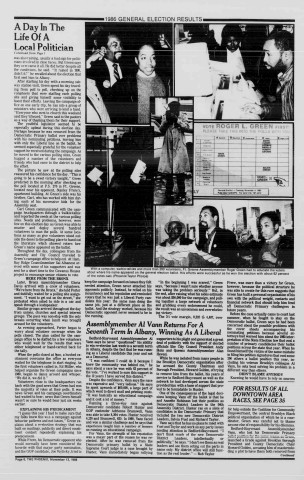
A Day In TheLife Of ALocal Politici a nContinued from Page Iwas also raining, usually a bad sign for politicians involved in close races. But Green says they ovei came it all. He did better despite all the conditions, he said. %u201c It rained in 1980, didn't it?' he recalled about the election that first sent him to Albany.After starting his day with a morning subway station visit, Green spent his day traveling from poll to poll, checking up on the volunteers that were staffing each polling site and giving himself some visibility to boost their efforts. Leaving the campaign office on one early trip, he ran into a group of ministers who were arriving to lend a hand. %u201cEveryone who went to church this weekend said they%u2019d heard,%u201d Green said to the pastors as a way of thanking them for their support.The youthful legislator seemed to be especially upbeat during this election day. Perhaps because he was removed from the Democratic Primary ballot over problems with his nominating petitions, leaving him with only the Liberal line on the ballot, he seemed especially grateful for the volunteer support he received during the campaign. As he moved to the various polling sites, Green hugged a number of the volunteers and friends who had come to the district to help the effort.The picture he saw at the polling sites reassured his confidence for the day. %u201cThis is going to be a sweet victory tonight,%u201d Green predicted in the morning after checking on the pell located at P.S. 270 in Ft. Greene, located near his opponent, Stanley Frere%u2019s, apartment building. At Green%u2019s side was his brother, Carl, who has worked with him during each of his successive bids for the Assembly seat.Carl Green communicated with the campaign headquarters through a walkie-talkie and reported the needs at the various polling sites. Needs and problems, however, were few on this election day as Green was able to muster and deploy several hundred volunteers to man the polls. At some locations as many as give volunteers stood outside the doors to the polling place to hand out the literature which showed voters how Green%u2019s name appeared on the ballot.Throughout the day, colleagues from the Assembly and City Council traveled to Green%u2019s campaign office to help out. At 11am, Bay Ridge Councilmember Sal Albanese arrived with some of his supporters and was sent for a short time to the Gowanus Houses project to encourage senior citizens to vote.HERE FROM THE BRONX1986 G EN ER AL ELECTION RESULTSGeneral Editor %u2014 Tuesday, November 4, 1986 Pott* Open 8AM-9PM Tor Voter Into 797- 83??With a computer, walkie-talkies and m ore than 200 volunteers, Ft. Greene Assem blym em ber Roger Green had to educate the voterslout where his nam e appeared on the general election ballot. H is efforts were successful as he won the election with about 62 percentW/nSMSm mHR fjtt '%u25a0 /&* %u25a0 r.SK . %u2022>1f %u25a0 1- I *38It > JlfeSr| A Dtrtj&fcfr 8 C C d fl%u00bbf D utM m! |LfM A R IOC U O M Oi J ..............h E R M A NB A D IU L Oi * <>%u00ab%u00ab*%u2022* < R O B E R TA B R A M S* I S. &4MW M A R KG R E E Nv -t c m c t t MVOfcotywkfc7M A J O RO W E N S8 Suky Mwifccr %u00abrf R O G E R L . . - a - JG R E E N. { C M C%u00abkw%u00ab1 ly M%u00ab OLater, Bronx Assemblymember Gloria Davis arrived with a crew of volunteers. %u201cWe%u2019re here from the Bronx,%u201d she told Porter and dutifully waited for a polling site assignment. %u201cI want to get out on the street,%u201d she protested when asked to ride in a car and speak through a loudspeaker.Similar groups arrived throughout the day from unions, churches and special interest groups. The pace was non-stop with the only breaks occurring when lunch was brought around for the volunteers.As evening approached, Porter began to worry about volunteer coverage when the polls closed. The plan called for the campaign office to be staffed by a few volunteers who would wait for the results that were either telephoned or hand-carried back for the tally.When the polls closed at 9pm, a hushed excitement overcame the office as everyone waited for the telephone to start ringing. As the first volunteers called in, Ed Miller, who helped organize the Green campaigns since 1980, began to dance around and whisper, %u201cWe did it, we did it.%u201dVolunteers close to the headquarters ran back with the good news that Green had won the majority of votes at their polls. It was news Green and his campaign coordinators had waited to hear; news that Green himself wasn%u2019t so sure he would hear just six weeks earlier.EXPLAINING HIS PREDICAMENT%u201cI guess this year I had to make sure that my folks knew this was a campaign against behavior patterns and not issues,%u201d Green explains about a re-election strategy that was built on mailings, publicity and direct constituent contact repeatedly explaining his predicament.While Frere, his Democratic opponent who would normally have been considered the favorite with that major party nomination, and the GOP candidate, Joe Vcyticky, tried tokeep the campaign focused on issues they felt needed attention, Green never attacked his opponents publicly. Instead, he relied on his incumbency and his reputation and reminded voters that he was just a Liberal Party candidate this year: the same man doing the same job, just at a different place on the ballot. And the strategy worked, because his Democratic opponent never seemed to be in the running.%u201cIn the beginning I was scared,%u201d Green says, %u201cbecause I wasn%u2019t sure whether anyone was taking the problem seriously.%u201d But, in the end, after raising what his aides estimate was about $50,000 for the campaign, and pulling together a large network of volunteers and grabbing every endorsement he could, the result was an uncommon and overwhelming victory.The 2-1 vote margin, 8,223 to 4,407, overAssemblymember Al Vann Returns For ASeventh Term In Albany, Winning As A LiberalBedford-Stuyvesant Assemblymember Al Vann says he never %u201cquestioned%u201d his ability to win re-election last week to a seventh term in Albany, despite the fact that he was running as a Liberal candidate this year and not as a Democrat.%u201cI was confident I could do it because I knew the community was behind me,%u201d he says about a race he won with 63 percent of the vote. %u201cI%u2019ve worked to earn this support in the 12 years I have served this district.%u201d Despite the confidence, Vann says the race was expensive and %u201cvery tedious.%u201d He says he spent upwards of $60,000, a large part of which went to direct mail and printing costs. %u201cIt was basically an educational campaign and it cost a lot of money.%u201dRunning a three-way race against Democratic candidate Robert Hunter and GOP contender Adrienne Bramwell, Vann was able to take 8,264 votes. Hunter received 4,120 and Bramwell, 635. In 1980, Vann faced and won a similar challenge and he says that experience taught him a number of lessons on running an educational campaign.For Vann, the strength of his reputation was a major part of the reason he was reelected. After he was removed from the Democratic primary ballot by a State Supreme Court judge in a case brought by Hunter, Vann immediately began rallyingsupporters to his plight and generated a great deal of publicity with the support of elected officials like City Council President Andy Stein and Queens Assemblymember Alan Hevesi.While he was isolated from many people in the Brooklyn Democratic organization after he accused the County Chairman and Borough President, Howard Golden, of trying to remove him from the ballot, his years of service to Bedford-Stuyvesant as well as the network he had developed across the state provided him with a base of support that proved to be formidable to Hunter.One of the consequences of the legal decisions keeping Vann off the ballot is that he and Annette Robinson lost their positios as Democratic District Leaders in the 56th Assembly District. Hunter ran on a slate of candidates in the Democratic Primary that mcluded the two new Democratic District Leaders, Sylvia Fuel and Richard Taylor.Vann says that he has no plans to meet with Fuel and Taylor and work on any party issues needing attention in Bedford-Stuyvesant. %u201cI don%u2019t think much of the new Democratic District Leaders, intellectually or politically,%u201d he says. %u201cI don%u2019t see them as real leaders and see them acting out the parts in name only. My district office will still function as the real leader.%u201d %u2014 Rob TaylorFrere, was more than a victory for Green, however, because the political structure he was able to create for this race suggests that Green has built a personal organization of his own with the political weight, contacts and financial network that should help him fend off Democratic Prim ary challengers in future years.Before the case actually came to court last summer, when he fought to stay on the Democratic ballot, Green says he had been concerned about the possible problems with the coyer sheets accompanying his nominating petitions because several attorneys had warned him about the 1985 interpretation of the State Election law that cost a number of primary candidacies their ballot positions across the state that year. When he found himself the victim of the same mistake in filing his petition signatures that cost some 200 others a ballot position this year, including his veteran Brooklyn colleague Al Vann, he seta bout solving his problem in a different way than others.DIDN%u2019T BLAME ANYBODYKnowing he would have to rely on sourcesFOR RESULTS OF ALLDOW NTOW N AREARACES, SEE PAGE 35for help outside the Coalition for Community Empowerment, the central Brooklyn Black political organization of which he is a coordinator, Green was careful not to blame anyone else of responsibility for his dilemma.Bedford-Stuyvesant Assemblymember Vann, who lost his Democratic Primary i%u2014ii-A %u2014 %u2014 r 4-u-_____ __ - n ____ WUUUl p v o iu u u IWi U1V/ OU4UV/ 1 V/UOV/i 1 (40 U l e c u ,launched a tirade against Brooklyn Borough President and County Democratic Chair Howard Golden, accusing him of masterminding a plot to have them both removed fromContinuedPage 6, TH E PHOENIX, November 13, 1986


