


Page 265 - Demo
P. 265
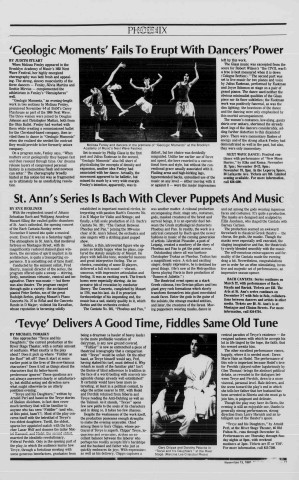
PHs e c t i o n : IX'Geologic Moments' Fails To Erupt With Dancers'PowerMolissa Fenley and dancers in the premiere of %u201cGeologic M om ents%u201d at the BrooklynAcademy of Music%u2019s Next Wave Festival.BY JUDITH STUARTWhen Molissa Fenley appeared in the Brooklyn Academy of Music%u2019s 1983 Next Wave Festival, her highly energized choreography was both fresh and appealing. The strong, sinewy muscularity of the three dancers %u2014 Fenley, Silvia Martins and Scottie Mirviss %u2014 complemented the athleticism in Fenley%u2019s %u201cHemispheres%u201d well.%u201cGeologic Moments,%u201d an evening-length work in two sections by Molissa Fenley, premiered November 4-8 at BAM%u2019s Carey Playhouse as part of the 1986 Next Wave. The three women were joined by Douglas Johnson and Christopher Mattox, both from the Ohio Ballet. Fenley had worked with them while creating a commissioned ballet for the Cleveland-based company, then invited them to dance in %u201cGeologic Moments%u201d when she realized she needed the contrast they would provide to her formerly unisex company.On a program note, Fenley says, %u201cWhen m atters occur geologically they happen fast and then resound through time. Our dreams release layers of compressed personal history in a momentous flash and newness can enter.%u201d The choreography broadly hinted at this notion but was so fragmented as to ultimately be an unsatisfying resolution.Set to music by Philip Glass in the first part and Julius Eastman in the second, %u201cGeologic Moments%u201d also fell short of physicalizing the concepts of density and expansion, another idea Fenley had associated with her dance. Actually, the movement appeared to be balletic, but missed its mark by a very wide margin. Fenley%u2019s intention, apparently, was todistort, but her choice was decidedly misguided. Unlike her earlier use of force and speed, she here resorted to a conventional form and style, but without the conventional grace usually associated with it. Flailing arms and high-kicking legs, hyperextended backs, unrealized use of the music on any level %u2014 either moving with it or against it %u2014 were the major impressionsleft by this work.The Glass music was excerpted from the score for Robert Wilson%u2019s %u201cthe CIVIL warS: a tree is best measured when it is down (Cologne Section).%u201d The second part was set to live music for two pianos and voice by Julius Eastman, performed by Eastman and Joyce Solomon on stage on a pair of grand pianos. The dance used neither the obvious minimalist qualities of the Glass piece nor its finer subtleties; the Eastman work was positively funereal, as was the dim lighting; the heaviness of the dance and the dancing were only emphasized by this morbid accompaniment.The women%u2019s costumes, low-slung, gauzy skirts over unitars, shortened the already short legs of the dancers considerably, adding further distortion to this disjointed piece. There were momentary flashes of energy and of the strong attack Fenley had demonstrated so well in the past, but alas, they were only momentary.NEXT WAVE DANCE: Festival continues with performance of %u201cNew Moon Stories,%u201d by Elko and Koma. November 18, 7pm; November 19-22, 8pm;November 23, 2pm. In the Lepercq Space, 30 Lafayette Ave. Tickets are (15. Limited seating available. For more information, call 636-4100.St. Ann's Series Is Bach With Clever Puppets And MusicBY EVE BERLINERWith the resplendent sound of Johann Sebastian Bach and Wolfgang Amadeus Mozart filling the vaulted gothic chambers of St. Ann%u2019s cathedral, the opening concert of the Bach Cantata Sunday series November 8 turned into quite a musical event. Even if it was on a Saturday night. The atmosphere in St. Ann%u2019s, that medieval fortress on Montague Street, with its magnificently restored stained glass windows, the elevation of spirit implicit in its architecture, is quite a transporting experience. It is something out of time itself.Conducted by the eminent cellist, Fred Sherry, musical director of the series, the program offered quite a sweep %u2014 stirring, lively, sometimes virtuosic, comical and imaginative. There was music %u2014 but there was also theatre. The program ranged through quite a variety: the acclaimed pianist Peter Serkin, son of the great Rudolph Serkin, playing Mozart%u2019s Piano Concerto No. 27 in B-flat and the Concerto Rondo in D Major; violinist Ida Kavafian, whose reputation is becoming solidlyestablished in important musical circles, interpreting with passion Bach%u2019s Concerto No. 2 in E Major for Violin and Strings; and finally, a full scale production of J.S. Bach%u2019s Cantata No. 201; %u201cThe Contest Between Phoebus and Pan,%u201d joining the 100-voice choir of St. Ann%u2019s School, the orchestra and solo singers with a striking giant puppet show.Serkin, a thin, introverted figure who appears so totally happy when he plays, captured the stately simplicity of Mozart. He plays with bell-like tone, wonderful nuances and great interpretive feeling. The orchestra, consisting of some 25 players, delivered a full rich sound %u2014 vibrant, sonorous, with impressive articulation and feeling. It was an exciting work. The french horns were especially stirring. An impressive job of evocation by conductor Sherry. %u2019Hie Concerto, completed by Mozart in 1791, was his last. As if in prescient foreknowledge of his impending end, the music has a sad, stately quality to it, which Serkin and the orchestra evoked.The Cantata No. 201, %u201cPhoebus and Pan,%u201dwas another matter. A colossal production encompassing choir, stage sets, costumes, gods, masked creatures of the forest and surreal beings, it is an operatic duel between the Greek mythological characters Phoebus and Pan. In reality, the work is a satirical comment by Bach upon the newer fashions in music of the coming generation of artists. librettist Picander, a poet of Leipzig, created a mockery of the story of Phoebus and Pan to get the point across.Outstanding above all was baritone Christopher Trakas as Phoebus. Trakas has a magnificent voice. A rich and exciting singer, deeply expressive, he is destined for great things. (He%u2019s now at the Metropolitan Opera playing Paris in their production of %u201cRomeo et Juliette.%u201d )The theatrical event opens on a stark Greek colossus, two Grecian pillars and two giant grey rock formations which slowly transform themselves into giant convoluted mask faces. Enter the gods in the guise of the soloists, the strange masked entities, and later, the creatures of the forest. Moving puppeteers wearing masks, dance inand out among the gods wearing ingenious faces and costumes. It%u2019s quite a production. The masks are designed and sculpted by Ellis Jacobson, who staged the Cantata with Barney Carlsen.The production seemed an awkward throwback to classical Greek theatre %u2014 the chorus, the gods, the masks. Though the masks were especially well executed, the staging imaginative and fun, the theatricality rarely blended smoothly with the music.The self-conscious extravagances and formality of the Cantata made the evening drag a bit. Nevertheless, congratulations are in order for an often stimulating, inventive and majestic set of performances, an impressive season-opener.BACH CANTATA: Series continues on March 22, with performance of Bach, Haydn and Bartok. Tickets are (12. The Arts at St. Ann%u2019s series continues on December 3-7 with Solo to Solo, collaborations between dancers and artists in other media. Tickets are (8. St. Ann%u2019s is at Montague and Clinton Streets. For more information, call 834-8794.'Tevye' Delivers A Good Time, Fiddles Same Old TuneBY MICHAEL TOMASKYOne approaches %u201cTevye and his Daughters,%u201d the current production at the River Stage Theater, with a certain amount of confusion. What exactly is the play about? Does it pick up where %u201cFiddler on the Roof%u201d left off? Does it start at some earlier point in the lives of the now-famous characters? Does it tell us things about the characters that its better-known predecessor ignores? These questions are not always answered clearly or satisfactorily, but skillful acting and direction save what might otherwise be an utterly pointless evening.%u201cTevye and his Daughters,%u201d written by Arnold Perl and based on the Tevye stories of Sholom Aleichem, in fact does cover much territory that will be familiar to anyone who has seen %u201cFiddler%u201d (and who, at this point, hasn%u2019t?). Most of the play concerns itself with the betrothal of Tevye%u2019s two eldest daughters; Tzeitl, the oldest, spurns her appointed match with the butcher Lazar Wolf and chooses the tailor Mot--1 J TT. J _ 1 il------IC1 lYdiiUiUU, atm UUUU, UK- OVW*ivt v/mwk,married the idealistic revolutionary,Feferal Perchik. Only in the opening part of the play, in which the audience learns how Tevye, through a fortuitous meeting with some generous benefactors, graduates frombeing a drayman (a hauler of heavy loads) to the more profitable vocation of dairyman, is any new ground covered.%u201cFiddler%u201d is now so entrenched a piece of theatrical iconography that a comparison with %u201cTevye%u201d would be unfair. On the other hand, as Tevye himself would say, Perl, having staked his turf, must defend it. Why rehash so much of the familiar plot? Isn%u2019t the theme of blind adherence to tradition in the face of a world boiling with scarcely imaginable change already well established?It certainly would have been more interesting, at least in a political context, to edge the action nearer to 1917, with Hodel and Perchik returned from Siberia and Tevye reading the Anti-Duhring as well as the Talmud. As it stands, %u201cTevye%u201d opens few new paths to the souls of its characters and in doing so, it takes too few chances.Despite the weaknesses of the work itself, the production possesses enough strengths to make the evening enjoyable. Chief among these is Gary Chipps, whose portrayal of Tevye is superb. Chipps%u2019 Tevye, loquacious aiui avun cular, strikes an excellent balance between the laborer who perhaps too readily accepts life%u2019s hardships and the husband and father who just as quickly embraces its joys. With expressions as well as his delivery, Chipps captures aGary Chipps and Dorothy Pelovitz in%u201cTevye and his Daughters \Stage. (Marcina Lee Cristobol Photo)central paradox of Tevye%u2019s existence %u2014 the resigned sadness with which he accepts his lot in life tinged by the hope, the faith, that his reward awaits him.The other excellent performance comes, happily, where it is needed most: Dawn Marie Hale as Hodel. The performance of this role is important because Hodel%u2019s love for Perchik (played rather lugubriously by Glen Thomas) brings the abstract political debate, as revealed in the dialogues between Tevye and Perchik, down to a more visceral, personal level. Hale delvers, and the scene toward the play%u2019s end in which she tells her father that her husband has been arrested in Siberia and she must go to join him, is poignant and delicate.Though the play may have its flaws, the evening is still an enjoyable one, thanks to generally strong performances, strong direction from Larry Homick and an intelligent use of the theater%u2019s space.%u201cTevye and his Daughters,%u201d by Arnold Perl, at the River Stage Theater, 46 Old Fulton St., runs through December 14. Performances are Thursday through Sunday nights at 8pm, with weekend matinees at 3pm. Tickets are (7 or TDF. For more information, call 852-7360.November 13, 198fi _ \I 7S %u25a0 m


