


Page 287 - Demo
P. 287
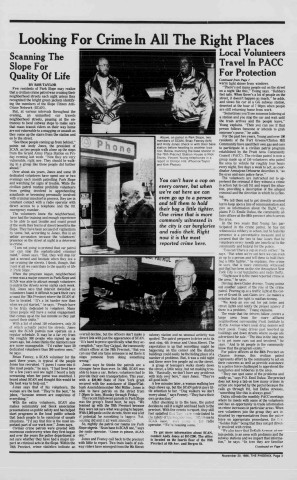
Looking For Crime In All The Right PlacesScanning TheSlope ForQuality Of LifeBY ROB TAYLORFew residents of Park Slope may realize that a civilian crime patrol was cruising their neighborhood streets each night unless they recognized the bright green jackets identifying the members of the Slope Citizen AntiCrime Network (SCAN).But, at various intervals throughout the evening, an unmarked car travels neighborhood streets, pausing at the entrances to local subway stops to make sure that mass transit riders on their way home are not vulnerable to a mugging or assault as they come up the stairs from the station and on to the street.%u201cSee these people coming up from behind,%u201d points out Andy Jones, the president of SCAN, as two people walk alone up the steps from the Grand Army Plaza Station on Friday evening last week. %u201cNow they are very vulnerable, right now. They should be walking in a group like those people did further ahead.%u201dOver about six years, Jones and some 30 dedicated volunteers have spent one or two evenings each month patrolling Park Slope and watching for signs of trouble. While the civilian patrol routine prohibits volunteers from getting involved in apprehending assailants or becoming personally involved with criminal mischief in process, they are in constant contact with a radio operator with direct access to a telephone and the 911 emergency number.The volunteers know the neighborhood, have had the training and enough experience to be able to spot trouble and sound proud of the work they feel is of direct benefit to the Slope. They have been accused of vigilantism by some, but, according to Jones, this is an unfair accusation oecause the volunteers%u2019 presence on the street at night is a deterrent to crime.%u201cI am not going to pretend that our patrol car can stop the sophisticated criminal mind,%u201d Jones says. %u201cBut, they will stop for just a second and hesitate when they see a car cruising the streets. I think, though, that most of all we contribute to the quality of life in Park Slope.%u201dWhen the program began, neighborhood crime was a ma jor concern in Park Slope and SCAN was able to attract enough volunteers to patrol the streets seven nights each week. But. Jones says that interest dwindled as volunteers found it difficult to park their cars around the 78th Precinct where the SCAN office is located. %u201cIt%u2019s a lot harder now than when we got started,%u201d he says. %u201c People have to be truly dedicated to volunteer. Many times people will have a social engagement that comes up at the last minute so they just cancel their shifts.%u201dWith a list of about 150 volunteers, only 30 of which actually patrol the streets, Jones says the SCAN patrols now operate on a regular schedule. It may be a far cry from the roughly 300 people who signed up six years ago, but Jones thinks the numbers now are more manageable. %u201cI%u2019d rather have 50 dedicated volunteers than 200 useless ones,%u201d he says.Brian Feeney, a SCAN volunteer for the past three years, is typical of the people Jones has recruited. %u201cI guess I came into it like most people,%u201d he says. %u201cI had lived here for a few years and one night I heard a lady screaming when her purse was snatched. I heard about SCAN and thought this would be the best way to help out.%u201dJones says that of his volunteers, the women are the best. %u201cThey%u2019re the best,%u201d he jokes, %u201cbecause women are suspicious of everything.%u201dWith the extra volunteers, SCAN also makes community and block association presentations on public safety and has helped start programs in the local public schools that teach people to be conscious of unsafe situations. %u201cI%u2019d say that this is the most important part of our work now,%u201d Jones says.Civilian crime patrols were greeted with enormous controversy when they first began and over the years the police department is not sure whether they have had a major impact on criminal acts in the Slope. Within the 78th Precinct, crime statistics indicate anAbove, on patrol in Park Slope, twomembers of SCAN, Brian Feeney (left)and Andy Jones check in with their basestation before heading to another location. Below, manning the base station inthe 78th Precinct Station House is NickStorey. Vincent Young telephones in areport in Clinton Hill. (Phoenix/Taylorand Kirk Photos)You can't have a cop onevery corner, but whenwe're out here we caneven go up to a personand tell them to holdtheir bag a little tighter.One crime that is morecommonly witnessed inthe city is car burglariesand radio theft. Rightnow it is the mostreported crime here.overall decline, but the officers don%u2019t make a direct link with just the appearance of SCAN. %u201cIt%u2019s hard to prove specifically what they accomplish,%u201d says Ray Cajigal, the community affairs officer at the 78th Precinct, %u201cBut you can say that any time someone is out there it stops someone from doing something wrong.%u201dJones says he thinks the patrols are a stronger force than ever. In 1985, SCAN was able to lease a car. Before, volunteers had to provide their own transportation. This year, with a $20,000 State of New York grant secured with the assistance of Slope/Flatbush Assemblymember Mel Miller, Jones is able to have patrols on the street from 7:30pm to lam, Monday through Friday.The recent Halloween parade in Park Slope was the group%u2019s finest hour, he says. %u201cWe teamed up with the 78th Precinct because they were not sure what was going to happen. With 2,500 peole on the streets, there was a lot of potential for something to happen. But, nothing did and it all went smoothly,%u201dS!o, nightly the patrol car roams the Park Slope streets. %u201cScan base to SCAN one,%u201d says the radio operator, \one.%u201dJones and Feeney call back to the precinct with little to report. Two train loads of subway riders have emerged from the 9th Streetsubway station and no unusual activity was spotted. The patrol prepares to drive on to its next stop, 4th Avenue and Union Street. The expectation is up that something might be happening on this corner and the shabby buildings could easily be the hiding place of a number of problems. But, it was a cold night and there were few people out on the street.A group of teenagers walks slowly down the street, a little noisy, but not making trouble. %u201cBasically, we don%u2019t have any problems with kids over here,%u201d says Jones. %u201cThey%u2019re all good kids.%u201dA few minutes later, a woman walking her dogs shows up, but the SCAN patrol pays little attention to her. %u201cDog walkers we don%u2019t worry about,%u201d says Feeney. %u201cThey have their own protection.%u201dAfter checking in to the base, the patrol decides to call it a night and head back to the precinct. With few events to report, they still feel satisfied tU i ! > . e contributed tothe safety of the %u2022>>,u. %u201dC, N one toSCAN base, ^ the radiooperator. %u201cWe%u2019re heading dome.To get more information about SCAN, contact Andy Jones at 857-2200. The office is located on the fourth floor of the 78th Precinct at 6th Ave. and Bergen St.Local VolunteersTravel In PACCFor ProtectionContinued from Page Iwarm light shines from windows.%u201cThere%u2019s not many people out on the street on a night like this,%u201d Young says. %u201cRobbers feel safe. When there%u2019s a lot of people on the street, it doesn%u2019t happen as much,\and slows his car at a GG subway station, deserted at the hour of 7:30pm when people are still returning home from work.%u201cSometimes you%u2019ll see someone loitering at a station and you stop the car and wait until the train arrives and the people leave,%u201d Young explains. %u201cThen you can see if that person follows fomeone or intends to grab someone%u2019s purse,%u201d he adds.For the past two years, Young and over 100 residents of the Fort Greene/Clinton Hill Community have used their own gas and cars to participate in a civilian patrol program established by the Pratt Area Community Council (PACC). The civilian patrol is now a group made up of 150 volunteers who patrol the area by vehicle for roughly four hours every night, five days a week to act, as coordinator Armajean Orbourne describes it, %u201cas the eyes and ears police force.%u201dThe volunteers are instructed not to apprehend the criminal if they witness a crime in action but to call 911 and report the situation, providing a description of the alleged criminal and the direction in which he is fleeing.%u201cWe tell them not to get directly involved but to keep open a line of communication and give us information about the flight,%u201d explains P.O. Emile Dufau, the community affairs officer at the 88th precinct which serves the area.In the two years that Young has participated in the crime patrol, he has not witnessed a robbery in action, but he feels his presence is a preventative measure and is assured that the two to four hours that he volunteers every month are beneficial to the community and helpful for the police.%u201cYou can't have a cop on every corner,\says. %u201cBut when we%u2019re out here we can even go up to a person and tell them to hold their bag a little tighter.%u201d he explains. One crime he says, that is more commonly witnessed and that has been on the rise throughout New York City is car burglaries and radio thefts.%u201cRight now it is the most reported crime in the area,%u201d he says.Driving down Gates Avenue. Young points out another aspect of the role of the crime patrol. Peering up at a traffic light at the corner of Grand St. and Gates Ave.. he makes a notation that the light is malfunctioning.%u201cWe keep an eye out for pot holes and street lights and notify the proper agency if there is a problem.%u201d Young explains.The route that the drivers follow, covers a large area from the more affluent neighborhood surrounding Pratt Institute to Myrtle Avenue where local drug dealers sell their goods. Young drives past boarded up buildings and down streets where co-ops are advertised for sale. %u201cThe idea in the long run is to get more cars out and involved,\says. %u201cAnd to let people in the community know that the program exists.%u201dFor police officers at the 88th Precinct on Classon Avenue, this civilian patrol represents effort by the community to act on their concerns as well as provide assistance to a police force challenged to apprehend the burglaries and robberies in the area.%u201cThey can spot some of the problems and notify us,%u201d says P.O. Emil Dufau. The precinct does not keep a tab on how many crimes in action are reported by the patrol because the calls go through 911, but Dufau stresses, %u201csomething like this is always good.%u201dDufau attends the monthly PACC meetings where he meets with some of the volunteers and has an opportunity to trade information on crime increases in particular areas. When new volunteers join the group they are instructed by representatives from the police force on appropriate procedures, the f: s. %u201cGolden Rule%u201d being that they not get directly involved with crime.1 iWTa olo<\\ Ifnnnf IKoi Hnlf oik Arrnniio of nor. \ %u2014 ----tain points, is an area with problems and the subway stations and we impart that information,%u201d he says. %u201cIn turn they are familiar Continued on Page 4November 20, 1986, THE PHOENIX, Page 3


