


Page 101 - Demo
P. 101
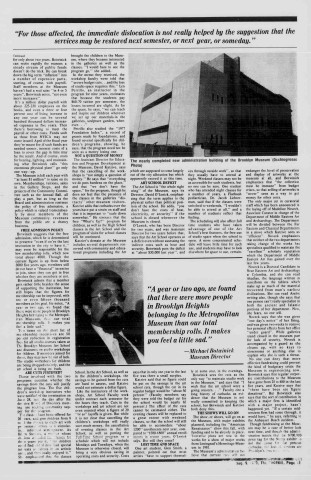
%u201cFor those affected, the immediate dislocation is not really helped by the suggestion that theservices may be restored next semester, or next year, or someday. %u201dContinuedfor only about two years. Botwinick can recite rapidly the reasons a steady stream of public funds doesn%u2019t do the trick. He can break down the big term %u201c inflation%u201d into a number of expensive parts, starting, of course, with payroll. Staff members at the Museum haven%u2019t had a real raise %u201c in 4 or 5 years%u201d , Botwinick notes, %u201c not even merit increases%u201d .It%u2019s a million dollar payroll with about 225-230 employees on the books, and even a three or four percent cost of living increase in any one year can be several hundred thousand dollars increased expenses in five years. Then there's borrowing to meet the payroll or other costs. Funds such as those from NYSCA may not come in until April of the fiscal year they%u2019re meant for; if such funds are needed sooner, interest costs of a loan to cover the gap in time may be the result. And of course, costs for heating, lighting, and maintaining what Botwinick calls %u201c this enormous physical plant%u201d go only one way%u2014up.The Museum is left each year with %u201c at least $1 million%u201d to raise on its own. Memberships, tuitions, sales in the Gallery Shops, and the projects of the Community Committee such as the Annual Ball, all play a part, but as long as the Board and administration continue the policy of free admission, a policy which is valued tremendously by most members of the Museum community, revenues from the public are a chancy business.FREE ADMISSION POLICYBotwinick suggests that the free admission, which he is determined to preserve %u201c even if we%u2019re the last institution in the city to have it,%u201d may even be responsible for the low membership rolls, which now total about 4000. Though the current figure is up from below 3000 five years ago, members still do not have a %u201c financial%u201d incentive to join, since they can get in free whether they are members or not. Botwinick admits that a member gets rather little besides the sense of supporting the institution, but still hopes that the figures for membership can be improved, with ter: or even fifteen thousand members as his goal. He notes, %u201c A yea- or two ago, we found that there were more people in Brooklyn Heights belonging to the Metropolitan Museum, than our total me nbership rolls. It makes you fee%u2019 a little sad.%u201dT\\ o items on the short list of membership incentives are 50 pes ent reduction in registration fees for all studio courses taken at The Brooklyn Museum Art School and discounts on studio workshops for hildren. If members joined for the .e, they may now be out of luck. The studio workshops for children arc being dropped entirely, and the art school is being cut back.ARE CUTS JUSTIFIED? Those involved with the two programs question whether the savings from the cuts will justify the program loss. The five children's workshop instructors who weie notified of the termination on Jut e 28, jus the day after the de; sive B -r 's of Directors meeting are seek tag community suppor for the program.T: e class Have been offered for 20 ears, and give children from 8 to 1 the ef %u2022 ice to study art with %u2022msts .%u00bb i stimulatsi atm sphere. As n, a r%u2018i cr whosebrought the children to the Museum, where they became interested in the galleries as well as the classes. %u201c 1 would hate to see the program go,%u201d she added.In the memo they received, the workshop faculty were told that %u201c severe budget cuts. . .and the loss of studio space requires this.%u201d Len Petrillo, an instructor in the program for nine years, estimates that because the students pay $60-70 tuition per semester, the losses incurred are slight. As for the space, he says, %u201c we can teach and inspire our children wherever we set up our materials-in the galleries, sculpture garden, wherever. . .%u201dPetrillo also studied the %u201c 1977 Foundation Index%u201d , a record of grants made by foundations, and found several specifically for children%u2019s programs, showing, he says, that the program need not be seen as a money losing one.NOT A QUESTION OF MONEYThe Assistant Director for Education and Program Development at the Museum, David Katzive, says that the cancelling of the workshops is %u201c not simply a question of money.%u201d He says that %u201c everything we do puts burdens on the place,%u201d and that %u201cwe don%u2019t have the space,%u201d for the program, though he does not feel that the presence of the classes in the galleries %u201c distracts%u201d other museum visitors. Katzive adds that cutbacks over the years have put a strain on staff and that it is important to %u201c scale down somewhat.%u201d He stresses that the free %u201c What%u2019s Up?%u201d program for children, as well as the High School classes in the Art School and the program of visits for school classes will be continued.Katzive%u2019s domain at the Museum includes several departments concerned with community and educational programs including the ArtThe nearly completed new administration building of the Brooklyn Museum (OcchiogrosscPhoto).which are supposed to come largely out of the city allocation but which apparently exceed it at this time.ART SCHOOL DEFICITThe Art School is %u201c the whole right wing%u201d of the Museum, says its Director, David O%u2019Lenick, emphasizing that the term applies to the physical rather than political position of the school. He adds, %u201c you don%u2019t have the costs of heat, electricity, or security%u201d if the school is closed whenever the Museum is closed.O%u2019Lenick, who has been Director for two years, and was Assistant Director for two years before that, says that the Art School operates at a deficit even without assessing the indirect costs such as heat and security. Botwinick puts the deficit at %u201c about $30,000 last year%u201d , andves through outside work%u201d , so that they usually have to attend at night. Weekend classes may not be as accessible for such students, but no one can be sure. One student who has attended night classes for a number of years, a Flatbush pediatrician, Dr. Jacob Lichterman, said that if the classes were switched to weekends, %u201c 1 wouldn%u2019t be able to attend at all,%u201d and a number of students reflect that feeling.The scheduling wilj also affect full time students who have taken advantage of one of the Art School%u2019s best features, the free use of studio space when the school is open. A more concentrated schedule will leave little time for such use, and students may have to look elsewhere for space to use, certainprin,,Hr1 the c%u2019 %u2022>ssion info?*n Ste cn. iren a thr e years co: d find int -ests o arc , and th> vaUvU n%u00bbv.put it, %u2018 re children lit if the* Had special dents in an artistic really enjoyed it.%u2019Sh emphasized that die classesSchool. In the Art School, as well as in the children%u2019s workshops, the savings to be gained from the cuts are hard to assess, and Katzive would not estimate a dollar figure.Like the instructors of the workshops, Art School Faculty work under contract each semester for the hours they teach. Cuts in the workshops and art school are not even counted when a figure of 20 %u201cor so%u201d layoffs is given. But while it is not clear that cancelling the children%u2019s workshops will really save much money, the cancellation of evening classes in the Art School, as well as putting theP . - 11 T i ^ C %u00ab L


