


Page 25 - Priorities #46 2010-March/April
P. 25
23
individual. “I don’t have a one-size fits all mentality with kids. I’ve gotten better and better every year at listening more, and then helping kids, guiding them, to what’s going to fit for them.” Together with students, Martignetti comes up with what she calls “work-arounds,” customized strategies to meet particular learning needs.
With a student who has difficulty writing, for example, she’ll probe for a solution. “I’ll say, OK,
what can we do to make it easier?
Do you need oral rehearsal, do
you need a different kind of out-
line, would you like to write your
ideas on a white board?” Some of
the alternatives she offers come in
the form of technological tools like
Inspiration software, which helps
students organize their ideas for
writing, and Dragonspeak, a new
program enabling kids to speak
their essays into the computer,
creating a rough draft from which
they can edit. “It’s going to be ter-
rific for the reluctant writers, for the kids who are dysgraphic,” Mar- tignetti says, and then she pauses. “We’ll see, we’ll try it. Again, there isn’t one size that fits all.”
In designing work-arounds, Martignetti pays careful attention to what a student’s innate strengths are. She explains, “There are kids who can’t remember anything they read but can remember everything that they hear. I ask them, ‘Have you ever thought about reading aloud from your textbook? Have you ever thought about downloading your textbook onto your iPod so you can listen to it?’”
Marlena Rivera, a sophomore, describes the work-around Mrs. Martignetti helped her find. “Writing things down for me is the best way that I learn. What she thought of was T-charts. I put the vocabu- lary words on one side and definitions on the other, and that really helped me for Bio and history.”
According to Brother Edward, offering such customized tools for learning is very much in keeping with teachings of St. Benedict. “One of the things that is very clear in the Rule and in the mind of Benedict is that you were always to respond to people on their own level. Not everybody is the same. There are different people with different needs allonthejourney. TakingitrightdowntoeducationatthePriory— yes,weknowtheyarecapableofthework. Someneeddifferenttypes of support than others. And in order to have those children succeed, that’s what we need to provide for them.”
With so many students feeling stressed these days, often what’s needed most is emotional support. “Kids don’t learn when they’re
shut down emotionally,” Martignetti says. “And kids don’t learn when they’re afraid, or when they’re overwhelmed.” For some stu- dents, even small failures can feel devastating. “It’s hard to have perspective when you’re 15 or 16. Getting an F on a biology test can feel like the end of your life. When really it’s like, OK, how do we start this over again?” She laughs. “Always we begin again!”
found uncomfortable at first. “I get it compliment,” she says.
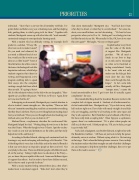
English teacher Cory Olcott sees the value of the kinds of support Mrs. Martignetti provides. “We all need a Sandy in our lives to keep us on task and to encourage us when we’re frustrated or feeling overwhelmed. Sandy is the ‘mom’ who not only makes sure the kids get their work done but also helps them work through the chal- lenges.” In fact, some kids actually call Mrs. Martignetti “campus mom,” a name she now that it’s actually a great
One remarkable thing about the Academic Resource Center is the complete lack of stigma around it. Students of all achievement lev- els feel comfortable here. Martignetti says, “If you look in my study hall sections right now, I have kids with nearly straight As and kids who are struggling, and they’re all working in the same space and they’re all cooperative. But I think that’s just a hallmark of the Priory. We have really kind, accepting kids.” Brian Nguyen, a sophomore, agrees—there’s no embarrassment. “It’s a place where people can chill out, do their work. I think people say, “Oh, you’re lucky, you get to go to study hall.”
Such a lack of judgment, says Brother Edward, is right in line with the Benedictine tradition. “All these are just tools to help the person ultimately arrive at wisdom. Without saying what it is. But arriving at that stage. That’s where the lifelong learner comes in. If we can help the students realize what their strengths are and what their challenges are, and strategies to help them with their challenges, then we’ve put them on the road to success.”


