


Page 19 - Priorities #34 2006-July
P. 19
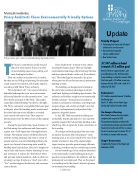
Performing Arts Groundbreaking
Priory Architects Chose Environmentally Friendly Options
Priory trustees give a cheer as groundbreaking day finally arrives.
The Priory is committed to careful steward- ship of its environment. It also is in need of more building space, more parking, and more funding for facilities.
These two realities may seem to be in conflict, but they are not. With good planning, the education- al and natural environments will actually improve, according to MK Think, Priory architects.
The end product will “turn a paved site into a habitable landscape that is far more environmen- tally sound than the one that currently exists.” says Steve Kelley, principal of MK Think. That might sound like wishful thinking—but here’s a thought... The Priory community accomplished that same goal in the past, when the founding monks transformed the school site from a bare hillside to a wooded oasis created with native flora. These improve- ments promise to be the 2006 version of that original scenario:
Among the most interesting “green features” of the Performing Arts auditorium and classrooms is
a green roof—9,000 square feet of drought tolerant seedum. The seedum surface will blend effectively with the existing landscape and create a variety of natural solutions to normal building problems, the report says. Instead of increasing water runoff by building more hard surfaces, this roof is designed to retain water and cleanse it before returning it to nor- mal waterways. It reduces the “heat-island” effect, and provides natural insulation—both of which cre- ate energy savings. It replaces a “dead” area with a “live” one that supports biodiversity and consumes carbon dioxide.
Does “biodiversity” translate to tiny critters invading the human space? There are multiple environmental and design effects that keep the flora and fauna planted firmly on the roof, the architects said. The technology has matured to the point where green roofs have become tested, mainstream building systems.
The buildings are designed and oriented on
the site to take maximum advantage of natural ventilation, lighting and shading opportunities. The architects and builders sought out environmentally friendly solutions—from paints and sealants to insulators, mechanical ventilation, and refrigerants. Carpets, drapes and concrete are high in recycled products, and engineered wood products help preserve old-growth forests.
In fact, MK Think succeeded in finding envi- ronmentally friendly alternatives to raw materials normally required by Portola Valley building codes, which may offer an option for future construction in the township.
The design and landscaping of the area create an outdoor classroom (the central plaza)—more learning space at no cost for much of the year. Three smaller structures in lieu of the original single, larger structure, provides greater energy efficiency in heating, ventilation and air conditioning systems.
Several months ago, Priory students interested in environmentally sound building practices pro- posed several possibilities to the architects, and the professionals were impressed. They see the project as a teaching tool in the school’s efforts to promote environmental stewardship.
C. Dobervich
Update
Trinity Project
• Performing Arts Center with all-school auditorium & new classrooms
• Renovated and expanded Library & Media Center
• New Student Center
$7.347 million in hand towards $13 million goal.
Board of Directors approved plans, and groundbreaking on the Performing Arts Center buildings is slated for Summer 2006. Short term goal is $2 million in new com- mitments by July 2006, with a total of $5 million by Fall 2007.
Endowment
$2.2 million committed towards $5 million fundraising goal.
Goal is $1 million for the Father Egon Scholarship Fund by December 2008.
On-Campus Housing
Maas Family Commons housing complex completed and occupied in 2003.
Two apartments adjoining residence halls constructed and one home renovated in 2001. Twenty-three faculty and staff live on campus. Trustees’ long-term goal is to house 50% of the faculty on campus within ten years.
Chapel Renovation
Completed by Friends of the Chapel and dedicated in 2004
19


