


Page 36 - Priorities #61 2015-April/May
P. 36
36
The Priory Robotics team did well at Madera in the Central Valley Regional competition, placing in the middle of the pack at 34 out of 50 teams. Unlike previous years, our robot was on the field and working every single match. We scored autonomous mode points in every single match. Unfortu- nately, stacking totes (yellow and gray rectangular plastic storage containers) on the scoring platforms did not go as well; we had very little testing time under our belts and were besieged with a host of problems during the tournament. But the bright spot was just how well the team worked together.
After every single match we discovered yet another issue with the capabilities and the functioning of our robot. And every time the team pulled together to find a quick, pragmatic solution to the problem and went back out and tried again only to discover another issue. Team Priory did not get dis- couraged and met each new challenge with vigor. So it was a proud moment when I saw them stack totes and place them on the scoring platform in their penultimate match.
The competition was dominated by several powerhouse teams: we were up against Bellarmine, who won the Nation- als last year and Citrus Circuits who was runner-up. These are very large teams that have twice as many mentors as Pri- ory has students on our team. Their robots are professionally designed and built. The judges were very impressed to find out that our robot was entirely designed and built by such a small band of students, without any hands-on work done by mentors or parents, and that we did not send any parts out for fabrication at a machine shop.
A quick summary of some of the issues we encountered:
Our robot was sizeable with a very large gripper mechanism protruding out the front. This hampered our ability to move around the field and got in the way of other robots on our alli- ance. We did not anticipate that the gripper would be pointed down (or up) depending on how the robot was positioned on the scoring platform when attempting to grab totes out of a landfill, an area in the center of the field containing totes and recycle bins to be stacked on the scoring platforms. This cur- tailed our ability to pick up totes. The gripper mechanism requires that the driver precisely position the robot — some- thing that is difficult to do when the operator is many feet away from the robot and in the heat of match. There were some structural support issues with both the gripper and the elevator mechanism. The point here is to show what the team had to deal with during the competition. The fact that they were able to resolve each issue well enough to score totes by the end of the competition is amazing. Even though we had more time to exercise the robot on “bag night” (the very last day of build season when all teams must stop working on their robots at midnight. At that point the robot must be put into a very large plastic bag with a seal) than ever before, demonstrated that we really need several days at the end of build week to iron out problems like these before competition — a lesson learned for next year.
We also discovered a strategy that was not apparent be- fore attending this competition. The very strong teams were quite good at taking totes from the feeder stations quickly, stacking them (quite high) and scoring. At this time such mastery of machinery is beyond our team. But time will tell.
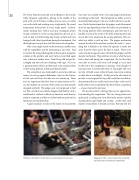
Bagging the robot - it has to stay in this sealed bag and only comes out during the competitions.
Working on the robot in the pit (Liam is very trusting of our new cart).


