


Page 100 - Handout Digital Electronics
P. 100
When S = 0 and R = 0, Q = 1 and Q = 1. This input combination is not allowed as it is also a race
            condition or ambiguous case. The rest of the input combinations do not bring about ambiguous cases.
            See state table below:

                  S         R          Q           Q           Name
                  0         0          x           x           Not allowed
                  0         1          0           1           Reset (clear to 0)
                  1         0          1           0           Set to 1 (store)
                  1         1          1           0           Set to 1 (store)


              SR latch symbol


            As  can  be  seen  from  the  state  table  above,  the  SR  latch  implemented  on  NAND  gates  only  is  also
            affected  by  the  ambiguous  case.  The  attempt  to  eliminate  this  ambiguous  case  continued  with  the
            introduction of the NAD gates and the clock to the SR latch.

            12.3 Clocked SR flip flop
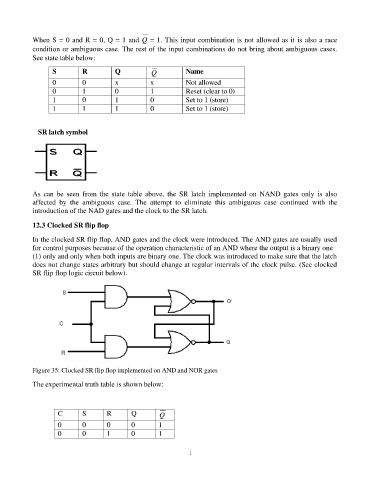
            In the clocked SR flip flop, AND gates and the clock were introduced. The AND gates are usually used
            for control purposes because of the operation characteristic of an AND where the output is a binary one
            (1) only and only when both inputs are binary one. The clock was introduced to make sure that the latch
            does not change states arbitrary but should change at regular intervals of the clock pulse. (See clocked
            SR flip flop logic circuit below).


            Figure 35: Clocked SR flip flop implemented on AND and NOR gates
            The experimental truth table is shown below:


                    C       S       R       Q         Q

                    0       0       0       0        1
                    0       0       1       0        1


                                                                100

