


Page 7 - Transformations: dialogues in art and material
P. 7
The Alchemy of Making
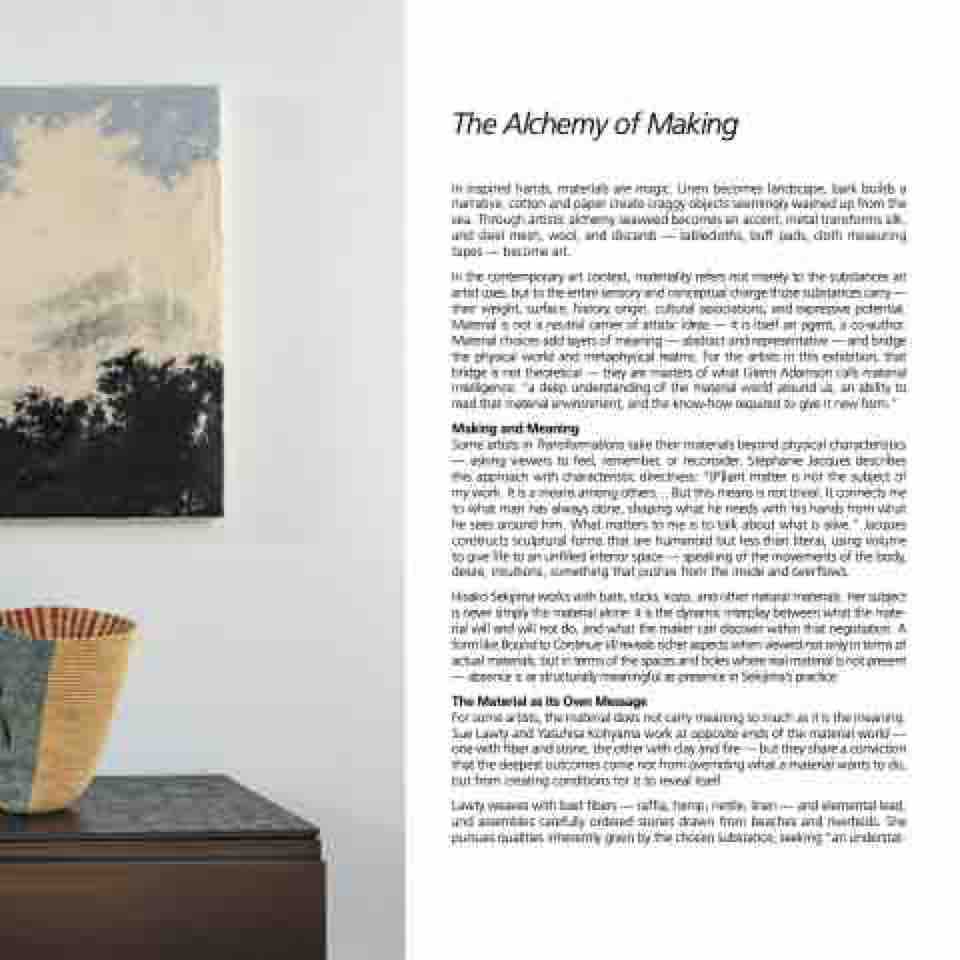
In inspired hands, materials are magic. Linen becomes landscape, bark builds a
narrative, cotton and paper create craggy objects seemingly washed up from the
sea. Through artistic alchemy seaweed becomes an accent, metal transforms silk,
and steel mesh, wool, and discards — tablecloths, buff pads, cloth measuring
tapes — become art.
In the contemporary art context, materiality refers not merely to the substances an
artist uses, but to the entire sensory and conceptual charge those substances carry —
their weight, surface, history, origin, cultural associations, and expressive potential.
Material is not a neutral carrier of artistic ideas — it is itself an agent, a co-author.
Material choices add layers of meaning — abstract and representative — and bridge
the physical world and metaphysical realms. For the artists in this exhibition, that
bridge is not theoretical — they are masters of what Glenn Adamson calls material
intelligence: “a deep understanding of the material world around us, an ability to
read that material environment, and the know-how required to give it new form.”
Making and Meaning
Some artists in Transformations take their materials beyond physical characteristics
— asking viewers to feel, remember, or reconsider. Stéphanie Jacques describes
7
this approach with characteristic directness: “[P]lant matter is not the subject of
my work. It is a means among others… But this means is not trivial. It connects me
to what man has always done, shaping what he needs with his hands from what
he sees around him. What matters to me is to talk about what is alive.” Jacques
constructs sculptural forms that are humanoid but less than literal, using volume
to give life to an unfilled interior space — speaking of the movements of the body,
desire, intuitions, something that pushes from the inside and overflows.
Hisako Sekijima works with bark, sticks, kozo, and other natural materials. Her subject
is never simply the material alone: it is the dynamic interplay between what the mate-
rial will and will not do, and what the maker can discover within that negotiation. A
form like Bound to Continue VII reveals richer aspects when viewed not only in terms of
actual materials, but in terms of the spaces and holes where real material is not present
— absence is as structurally meaningful as presence in Sekijima’s practice.
The Material as Its Own Message
For some artists, the material does not carry meaning so much as it is the meaning.
Sue Lawty and Yasuhisa Kohyama work at opposite ends of the material world —
one with fiber and stone, the other with clay and fire — but they share a conviction
that the deepest outcomes come not from overriding what a material wants to do,
but from creating conditions for it to reveal itself.
Lawty weaves with bast fibers — raffia, hemp, nettle, linen — and elemental lead,
and assembles carefully ordered stones drawn from beaches and riverbeds. She
pursues qualities inherently given by the chosen substance, seeking “an understat-


