


Page 41 - MENU - MARCH / APRIL
P. 41
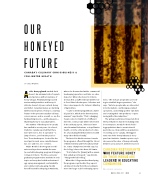
OUR
HONEYED
FUTURE
CANADA’S CULINARY CONSCIOUSNESS & POLLINATOR HEALTH
BY CAELI MAZARA
Arich, honey-glazed smoked duck breast. An autumnal side of squash and potatoes with a béarnaise of honey vinegar. Mouthwatering roasted venison with pistachios and honey. A delicate dessert of pear, custard, honey and millet. Canadian menus are bursting with honeyed options. Honey is a starring feature in the present Canadian culinary consciousness, and as a result, so are the hardworking insects—and beekeepers— that bring honey to Canadian tables.
The number of beekeepers in Canada has swelled in recent years. As of 2016, Statistics Canada reported that there were well over 9,800 in operation—a jump of over 1,200 from the year be- fore. These beekeepers, located for the most part in rural areas, mind between 750,000 and 800,000 colonies.
Mylee Nordin is the Program Coordi- nator and a professor within the new- ly-created Beekeeping program at Niagara College in Ontario. The three-semester graduate program trains students in such topics as honey bee health and entomol- ogy, apiary management, sustainability and commercial beekeeping. Nordin herself learned beekeeping in Manitoba,
where she then worked with a commercial beekeeping operation, and later, as a bee inspector. When she moved to Ontario, she was  rst a sta  beekeeper with Toron- to Food Share’s Beekeepers Collective and later a bee inspector for Ontario’s Ministry of Agriculture.
“I came to beekeeping without a famil- ial past in it, which at the time was very unusual,” says Nordin. “That’s changing. People come to it with lots of di erent interests. Some people will be interested in the culinary aspect, others are inter- ested in animal behaviour, or in pollinator health, or in the other products of a hive. It’s a fascinating  eld that intersects with many other  elds of study.”
The  rst of its kind in eastern Canada, the program is o ered through the School of Environmental and Horticultural Stud- ies. It was championed, Nordin says, by the College’s Associate Dean, Al Unwin.
“It all started for [Unwin] with a swarm that ended up in his yard,” says Nordin. “That got the ball rolling.”
When the College was  rst developing the program, says Nordin, they expect- ed interest mostly from those looking to move into large-scale beekeeping opera-
tions. “We do have people who are look- ing to establish larger operations,” she says, “but also people who are interested in niche markets, and doing specialized operations, and setting up their own hives and creating their own products, or part- nering with other industries.”
The widespread interest may stem from the fact that bees have been making news in recent years, mostly for their declin- ing populations due to neonicotinoid pesticide use. Now, with bee populations recovering across Canada, the biggest news out of the honey industry is its 13- year low. Statistics Canada reports a 25% decrease in the value of honey nationally between 2015 and 2016, with decreases in
Canadian restaurants
who feature honey
on their menus are
leaders in educating
consumers.
CONTINUED ON PAGE 42
MARCH / APRIL 2017
MENU 41


