


Page 27 - Family Wellness - Spring/Summer 2016
P. 27
on them that limit what a person can do. Water can help counteract these limitations by providing an environment that allows for more flexibility and freedom. “Being in water activates a wider range of muscles,” says Karam. “This is ideal for people dealing with ongoing chronic issues that make them unable to tolerate physical therapy. When they’re in water they can go through a more complete range
of motion.” He adds that being in water allows people recovering from injuries to exercise longer.
While water-based exercise
is great for injury recovery and physical therapy, more and more people are now using aqua classes to build up their overall fitness too. Where previously, water workouts were tranquil gatherings filled with grannies in swim caps bobbing up and down to Celine Dion tunes, there are now plenty of options
for more aggressive training that doesn’t involve noodles and water buoys. Regardless of your fitness level, there’s probably an aqua class out there that delivers a demanding cardio and strength- building workout.
Interval-style water workouts focus on driving up your heart rate and bringing it back down to burn calories and work your heart in a low-impact format. They commonly combine cardio, resistance, and stretching activities like jumping jacks and lunges with plyometric jumps and water running. There
are water-based exercises you can do for every muscle group, and
your risk of injury is extremely low. Pushing through the water as fast as possible creates turbulence, which adds resistance to the workout, and increases the difficulty. You can add weights to make each move even more challenging. Anything you do with dumbbells can be translated into a water exercise. And if you already have a free-weight routine, you can take it under water to make it more effective.
Get Fit
Swimming is a physically demanding activity that works your heart, and the muscles in your legs, arms,
Spring/Summer 2016
get ready
Water
Safety
➜The first rule of the water is to never go in alone. Safety always comes first, which means follow- ing the directions of lifeguards since they can see and anticipate things that you can’t.
➜Pools, lakes, and rivers are shared spaces, so you need to be consciously aware of those around you as you do your aquatic workout.
➜If you’re swimming in lakes or oceans, you have to be very care- ful of currents, water tempera- ture, and other obstacles.
➜Even though you’re in water, you need to make sure you stay hydrated. Most water newbies forget to drink during workouts because they don’t feel that they’re sweating—but they are.
25
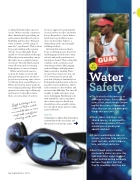
Goggle technologies have
improved. Newer models are available that are more comfortable and effective at sealing out the water.


