


Page 166 - Handout Computer Network.
P. 166
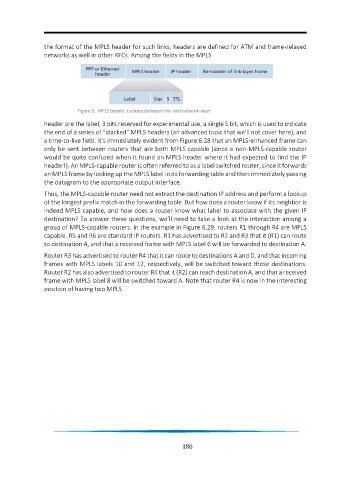
the format of the MPLS header for such links; headers are defined for ATM and frame-relayed
                 networks as well in other RFCs. Among the fields in the MPLS


                            Figure 6:  MPLS header: Located between link- and network-layer
                 header are the label, 3 bits reserved for experimental use, a single S bit, which is used to indicate
                 the end of a series of “stacked” MPLS headers (an advanced topic that we’ll not cover here), and
                 a time-to-live field. It’s immediately evident from Figure 6.28 that an MPLS-enhanced frame can
                 only be sent between routers that are both MPLS capable (since a non-MPLS-capable router
                 would be quite confused when it found an MPLS header where it had expected to find the IP
                 header!). An MPLS-capable router is often referred to as a label switched router, since it forwards
                 an MPLS frame by looking up the MPLS label in its forwarding table and then immediately passing
                 the datagram to the appropriate output interface.

                 Thus, the MPLS-capable router need not extract the destination IP address and perform a lookup
                 of the longest prefix match in the forwarding table. But how does a router know if its neighbor is
                 indeed MPLS capable, and how does a router know what label to associate with the given IP
                 destination? To answer these questions, we’ll need to take a look at the interaction among a
                 group of MPLS-capable routers. In the example in Figure 6.29, routers R1 through R4 are MPLS
                 capable. R5 and R6 are standard IP routers. R1 has advertised to R2 and R3 that it (R1) can route
                 to destination A, and that a received frame with MPLS label 6 will be forwarded to destination A.
                 Router R3 has advertised to router R4 that it can route to destinations A and D, and that incoming
                 frames with MPLS labels 10 and 12, respectively, will be switched toward those destinations.
                 Router R2 has also advertised to router R4 that it (R2) can reach destination A, and that a received
                 frame with MPLS label 8 will be switched toward A. Note that router R4 is now in the interesting
                 position of having two MPLS


                                                                 186

