


Page 167 - Handout Computer Network.
P. 167
Computer Network                                                             2026


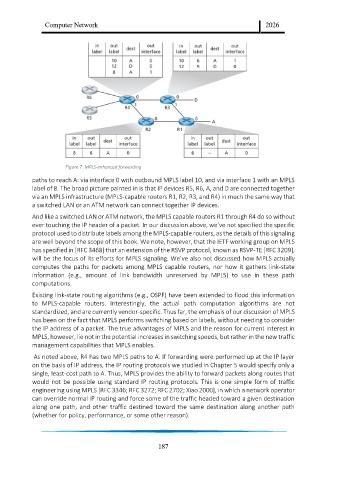
                        Figure 7: MPLS-enhanced forwarding

            paths to reach A: via interface 0 with outbound MPLS label 10, and via interface 1 with an MPLS
            label of 8. The broad picture painted in is that IP devices R5, R6, A, and D are connected together
            via an MPLS infrastructure (MPLS-capable routers R1, R2, R3, and R4) in much the same way that
            a switched LAN or an ATM network can connect together IP devices.

            And like a switched LAN or ATM network, the MPLS capable routers R1 through R4 do so without
            ever touching the IP header of a packet. In our discussion above, we’ve not specified the specific
            protocol used to distribute labels among the MPLS-capable routers, as the details of this signaling
            are well beyond the scope of this book. We note, however, that the IETF working group on MPLS
            has specified in [RFC 3468] that an extension of the RSVP protocol, known as RSVP-TE [RFC 3209],
            will be the focus of its efforts for MPLS signaling. We’ve also not discussed how MPLS actually
            computes  the paths  for packets  among  MPLS capable  routers,  nor  how it  gathers  link-state
            information  (e.g.,  amount  of  link  bandwidth  unreserved  by  MPLS)  to  use  in  these  path
            computations.
            Existing link-state routing algorithms (e.g., OSPF) have been extended to flood this information
            to  MPLS-capable  routers.  Interestingly,  the  actual  path  computation  algorithms  are  not
            standardized, and are currently vendor-specific. Thus far, the emphasis of our discussion of MPLS
            has been on the fact that MPLS performs switching based on labels, without needing to consider
            the IP address of a packet. The true advantages of MPLS and the reason for current interest in
            MPLS, however, lie not in the potential increases in switching speeds, but rather in the new traffic
            management capabilities that MPLS enables.

             As noted above, R4 has two MPLS paths to A. If forwarding were performed up at the IP layer
            on the basis of IP address, the IP routing protocols we studied in Chapter 5 would specify only a
            single, least-cost path to A. Thus, MPLS provides the ability to forward packets along routes that
            would not be possible using standard IP routing protocols. This is one simple form of traffic
            engineering using MPLS [RFC 3346; RFC 3272; RFC 2702; Xiao 2000], in which a network operator
            can override normal IP routing and force some of the traffic headed toward a given destination
            along  one  path,  and  other  traffic  destined  toward  the  same  destination along  another  path
            (whether for policy, performance, or some other reason).


                                                         187

