


Page 170 - Handout Computer Network.
P. 170
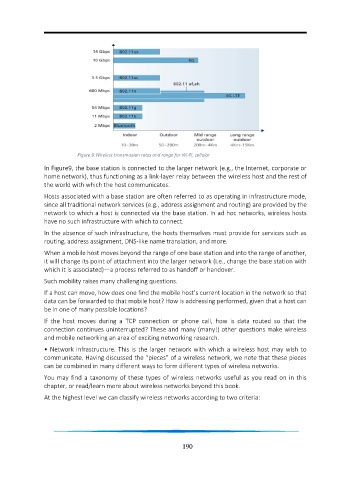
Figure 9:Wireless transmission rates and range for Wi-Fi, cellular
                 In Figure9, the base station is connected to the larger network (e.g., the Internet, corporate or
                 home network), thus functioning as a link-layer relay between the wireless host and the rest of
                 the world with which the host communicates.
                 Hosts associated with a base station are often referred to as operating in infrastructure mode,
                 since all traditional network services (e.g., address assignment and routing) are provided by the
                 network to which a host is connected via the base station. In ad hoc networks, wireless hosts
                 have no such infrastructure with which to connect.
                 In the absence of such infrastructure, the hosts themselves must provide for services such as
                 routing, address assignment, DNS-like name translation, and more.

                 When a mobile host moves beyond the range of one base station and into the range of another,
                 it will change its point of attachment into the larger network (i.e., change the base station with
                 which it is associated)—a process referred to as handoff or handover.

                 Such mobility raises many challenging questions.

                 If a host can move, how does one find the mobile host’s current location in the network so that
                 data can be forwarded to that mobile host? How is addressing performed, given that a host can
                 be in one of many possible locations?

                 If  the  host  moves  during  a  TCP  connection  or  phone  call,  how  is  data  routed  so  that  the
                 connection continues uninterrupted? These and many (many!) other questions make wireless
                 and mobile networking an area of exciting networking research.

                 • Network infrastructure. This is the larger network with which a wireless host may wish to
                 communicate. Having discussed the “pieces” of a wireless network, we note that these pieces
                 can be combined in many different ways to form different types of wireless networks.
                 You may find a taxonomy of these types of wireless networks useful as you read on in this
                 chapter, or read/learn more about wireless networks beyond this book.
                 At the highest level we can classify wireless networks according to two criteria:


                                                                 190

