


Page 194 - Handout Computer Network.
P. 194
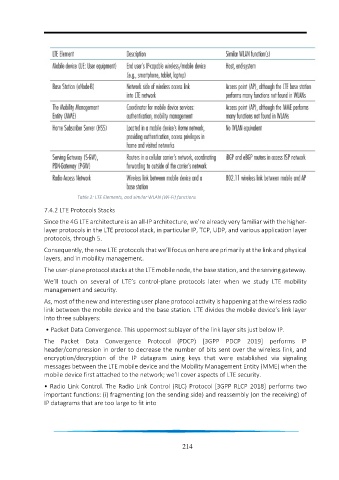
Table 2: LTE Elements, and similar WLAN (Wi-Fi) functions
                 7.4.2 LTE Protocols Stacks

                 Since the 4G LTE architecture is an all-IP architecture, we’re already very familiar with the higher-
                 layer protocols in the LTE protocol stack, in particular IP, TCP, UDP, and various application layer
                 protocols, through 5.
                 Consequently, the new LTE protocols that we’ll focus on here are primarily at the link and physical
                 layers, and in mobility management.
                 The user-plane protocol stacks at the LTE mobile node, the base station, and the serving gateway.

                 We’ll  touch  on  several  of  LTE’s  control-plane  protocols  later  when  we  study  LTE  mobility
                 management and security.
                 As, most of the new and interesting user plane protocol activity is happening at the wireless radio
                 link between the mobile device and the base station. LTE divides the mobile device’s link layer
                 into three sublayers:

                  • Packet Data Convergence. This uppermost sublayer of the link layer sits just below IP.
                 The  Packet  Data  Convergence  Protocol  (PDCP)  [3GPP  PDCP  2019]  performs  IP
                 header/compression in order to decrease the number of bits sent over the wireless link, and
                 encryption/decryption  of  the  IP  datagram  using  keys  that  were  established  via  signaling
                 messages between the LTE mobile device and the Mobility Management Entity (MME) when the
                 mobile device first attached to the network; we’ll cover aspects of LTE security.
                 • Radio Link Control. The Radio Link Control (RLC) Protocol [3️GPP RLCP  2018] performs two
                 important functions: (i) fragmenting (on the sending side) and reassembly (on the receiving) of
                 IP datagrams that are too large to fit into


                                                                 214

