


Page 195 - Handout Computer Network.
P. 195
Computer Network                                                             2026


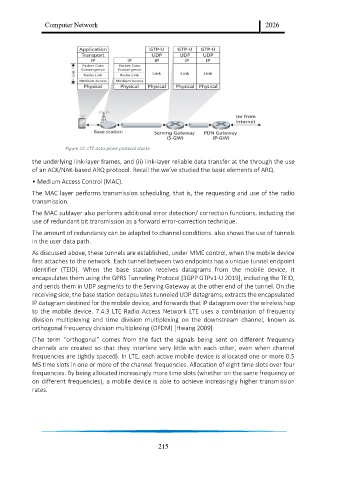
                        Figure 22: LTE data-plane protocol stacks

            the underlying link-layer frames, and (ii) link-layer reliable data transfer at the through the use
            of an ACK/NAK-based ARQ protocol. Recall the we’ve studied the basic elements of ARQ.
            • Medium Access Control (MAC).

            The MAC layer performs transmission scheduling, that is, the requesting and use of the radio
            transmission.
            The MAC sublayer also performs additional error detection/ correction functions, including the
            use of redundant bit transmission as a forward error-correction technique.
            The amount of redundancy can be adapted to channel conditions. also shows the use of tunnels
            in the user data path.

            As discussed above, these tunnels are established, under MME control, when the mobile device
            first attaches to the network. Each tunnel between two endpoints has a unique tunnel endpoint
            identifier  (TEID).  When  the  base  station  receives  datagrams  from  the  mobile  device,  it
            encapsulates them using the GPRS Tunneling Protocol [3GPP GTPv1-U 2019], including the TEID,
            and sends them in UDP segments to the Serving Gateway at the other end of the tunnel. On the
            receiving side, the base station decapsulates tunneled UDP datagrams, extracts the encapsulated
            IP datagram destined for the mobile device, and forwards that IP datagram over the wireless hop
            to  the mobile  device.  7.4.3  LTE  Radio  Access Network  LTE  uses  a  combination  of  frequency
            division  multiplexing  and  time  division  multiplexing  on  the  downstream  channel,  known  as
            orthogonal frequency division multiplexing (OFDM) [Hwang 2009].

            (The  term  “orthogonal”  comes  from  the  fact  the  signals  being  sent  on  different  frequency
            channels  are  created  so  that  they  interfere  very  little  with  each  other,  even  when  channel
            frequencies are tightly spaced). In LTE, each active mobile device is allocated one or more 0.5
            MS time slots in one or more of the channel frequencies. Allocation of eight time slots over four
            frequencies. By being allocated increasingly more time slots (whether on the same frequency or
            on different frequencies), a mobile device is able to achieve increasingly higher transmission
            rates.


                                                         215

