


Page 196 - Handout Computer Network.
P. 196
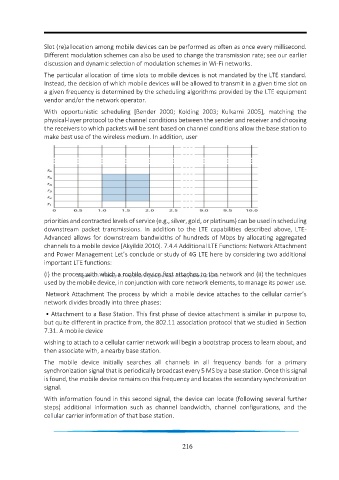
Slot (re)allocation among mobile devices can be performed as often as once every millisecond.
                 Different modulation schemes can also be used to change the transmission rate; see our earlier
                 discussion and dynamic selection of modulation schemes in Wi-Fi networks.

                 The particular allocation of time slots to mobile devices is not mandated by the LTE standard.
                 Instead, the decision of which mobile devices will be allowed to transmit in a given time slot on
                 a given frequency is determined by the scheduling algorithms provided by the LTE equipment
                 vendor and/or the network operator.

                 With  opportunistic  scheduling  [Bender  2000;  Kolding  2003;  Kulkarni  2005],  matching  the
                 physical-layer protocol to the channel conditions between the sender and receiver and choosing
                 the receivers to which packets will be sent based on channel conditions allow the base station to
                 make best use of the wireless medium. In addition, user


                 priorities and contracted levels of service (e.g., silver, gold, or platinum) can be used in scheduling
                 downstream  packet  transmissions.  In  addition  to  the  LTE  capabilities  described  above,  LTE-
                 Advanced allows for downstream bandwidths of hundreds of Mbps by allocating aggregated
                 channels to a mobile device [Akyildiz 2010]. 7.4.4 Additional LTE Functions: Network Attachment
                 and Power Management Let’s conclude or study of 4G LTE here by considering two additional
                 important LTE functions:
                            Figure 23:  Twenty 0.5-ms slots organized into 10 ms frames at each
                 (i) the process with which a mobile device first attaches to the network and (ii) the techniques
                 used by the mobile device, in conjunction with core network elements, to manage its power use.

                  Network Attachment The process by which a mobile device attaches to the cellular carrier’s
                 network divides broadly into three phases:
                  • Attachment to a Base Station. This first phase of device attachment is similar in purpose to,
                 but quite different in practice from, the 802.11 association protocol that we studied in Section
                 7.31. A mobile device
                 wishing to attach to a cellular carrier network will begin a bootstrap process to learn about, and
                 then associate with, a nearby base station.

                 The  mobile  device  initially  searches  all  channels  in  all  frequency  bands  for  a  primary
                 synchronization signal that is periodically broadcast every 5 MS by a base station. Once this signal
                 is found, the mobile device remains on this frequency and locates the secondary synchronization
                 signal.

                 With information found in this second signal, the device can locate (following several further
                 steps)  additional  information  such  as  channel  bandwidth,  channel  configurations,  and  the
                 cellular carrier information of that base station.


                                                                 216

