


Page 198 - Handout Computer Network.
P. 198
messages broadcast by the MME to base stations nearby the base station with which the mobile
                 was last associated.

                 These control-plane paging messages, which are broadcast by these base stations to all mobile
                 devices in their cells, indicate which mobile devices should fully wake up and re-establish a new
                 data-plane connection to a base station in order to receive incoming packets.
                 The Global Cellular Network:

                 A Network of Networks
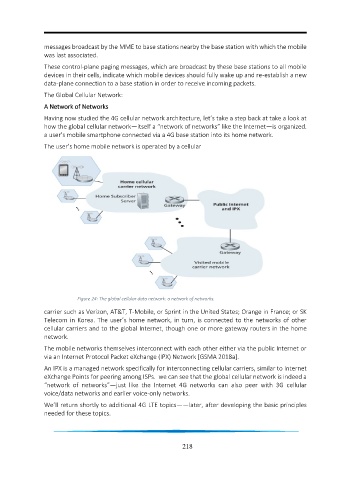
                 Having now studied the 4G cellular network architecture, let’s take a step back at take a look at
                 how the global cellular network—itself a “network of networks” like the Internet—is organized.
                 a user’s mobile smartphone connected via a 4G base station into its home network.

                 The user’s home mobile network is operated by a cellular


                            Figure 24: The global cellular data network: a network of networks.

                 carrier such as Verizon, AT&T, T-Mobile, or Sprint in the United States; Orange in France; or SK
                 Telecom in Korea. The user’s home network, in turn, is connected to the networks of other
                 cellular carriers and to the global Internet, though one or more gateway routers in the home
                 network.

                 The mobile networks themselves interconnect with each other either via the public Internet or
                 via an Internet Protocol Packet eXchange (IPX) Network [GSMA 2018a].
                 An IPX is a managed network specifically for interconnecting cellular carriers, similar to Internet
                 eXchange Points for peering among ISPs.  we can see that the global cellular network is indeed a
                 “network  of  networks”—just  like  the  Internet  4G  networks  can  also  peer  with  3G  cellular
                 voice/data networks and earlier voice-only networks.
                 We’ll return shortly to additional 4G LTE topics——later, after developing the basic principles
                 needed for these topics.


                                                                 218

