


Page 57 - Handout Computer Network.
P. 57
However, shielded cable is more difficult to install than unshielded cable because the
               metallic shielding needs to be grounded. If improperly installed, STP and ScTP become very
               susceptible to noise problems because an ungrounded shield acts like an antenna, picking up
               unwanted signals. STP and ScTP cable cannot be run as far as coaxial and fiber-optic cable
               without  the  use  of  repeaters.  The  insulation  and  shielding  considerably  increase  the  size,
               weight, and cost of the cable. Despite these disadvantages, shielded copper cable is still used
               as networking media today, especially in Europe.

                       The following summarizes the features of STP cable:

                          •  Speed and throughput—10 to 100 Mbps


                          •  Average cost per node—Moderately expensive

                          •  Media and connector size—Medium to large

                          •  Maximum cable length—100 meters (m) (short)


                    3.2.3. Unshielded Twisted-Pair Cable


                      Unshielded twisted-pair (UTP) cable is a common networking media. It consists of four
               pairs of thin, copper wires covered in color-coded plastic insulation that are twisted together,
               as shown in Figure below. The wire pairs are then covered with a plastic outer jacket. The
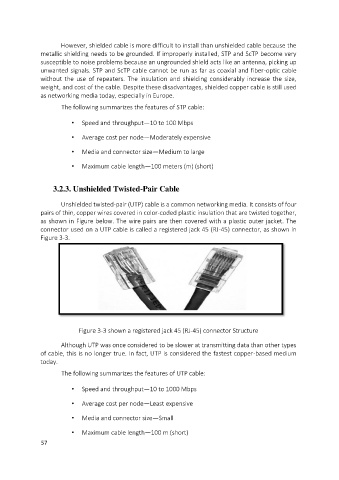
               connector used on a UTP cable is called a registered jack 45 (RJ-45) connector, as shown in
               Figure 3-3.


                             Figure 3-3 shown a registered jack 45 (RJ-45) connector Structure

                      Although UTP was once considered to be slower at transmitting data than other types
               of cable, this is no longer true. In fact, UTP is considered the fastest copper-based medium
               today.
                       The following summarizes the features of UTP cable:


                          •  Speed and throughput—10 to 1000 Mbps

                          •  Average cost per node—Least expensive

                          •  Media and connector size—Small

                          •  Maximum cable length—100 m (short)
               57

