


Page 58 - Handout Computer Network.
P. 58
Commonly used types of UTP cabling are as follows:


                          •  Category  1  (CAT  1)—Used  for  telephone  communications.  Not  suitable  for
                              transmitting data.
                          •  Category 2 (CAT 2)—Capable of transmitting data at speeds up to 4 Mbps.

                          •  Category 3 (CAT 3)—Used in 10BASET Ethernet networks. Can transmit data at
                              speeds up to 10 Mbps.

                          •  Category 4 (CAT 4)—Used in Token Ring networks. Can transmit data at speeds
                              up to 16 Mbps.
                          •  Category 5 (CAT 5)—Can transmit data at speeds up to 100 Mbps. Used in Fast
                              Ethernet networks.

                          •  Category 5e (CAT 5e)—Used in networks running at speeds up to 1000 Mbps
                              (1 Gbps). Used in Gigabit Ethernet (GigE) networks.
                          •  Category  6  (CAT  6)—The  specification  for  CAT  6  is  new,  was  released  on
                              February 3, 2003, and is currently available for installation and use. Used in
                              Gigabit Ethernet (GigE) networks.
                          •  https://www.youtube.com/watch?v=fgOkvIHKgXQ

                       3.3 Optical Media

                      Optical  fiber  is  the  most  frequently  used  medium  for  the  longer,  high  bandwidth,
               pointto-point transmissions required on LAN backbones and on wide-area networks (WANs).

                      Total Internal Reflection A light ray that is being turned on and off to send data 1s and
               0s into an optical fiber must stay inside the fiber until it reaches the far end. The ray must not
               refract into the material wrapped around the outside of the fiber because such refraction
               causes the loss of part of the ray’s light energy. A design for the fiber that makes the outside
               surface of the fiber act like a mirror to the light ray moving through the fiber must be achieved.
               If any light ray that tries to move out through the side of the fiber is reflected back into the
               fiber at an angle that sends it towards the far end of the fiber, this is a good pipe or wave guide
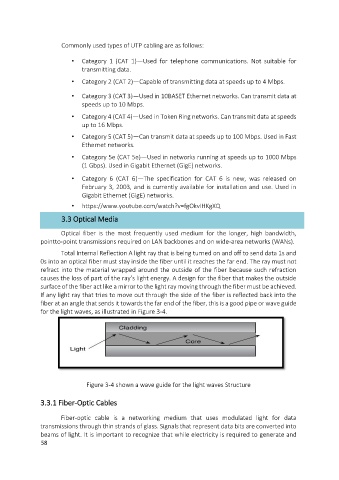
               for the light waves, as illustrated in Figure 3-4.


                               Figure 3-4 shown a wave guide for the light waves Structure


               3.3.1 Fiber-Optic Cables

                      Fiber-optic  cable  is  a  networking  medium  that  uses  modulated  light  for  data
               transmissions through thin strands of glass. Signals that represent data bits are converted into
               beams of light. It is important to recognize that while electricity is required to generate and
               58

