


Page 21 - 2026 January February Magazine
P. 21
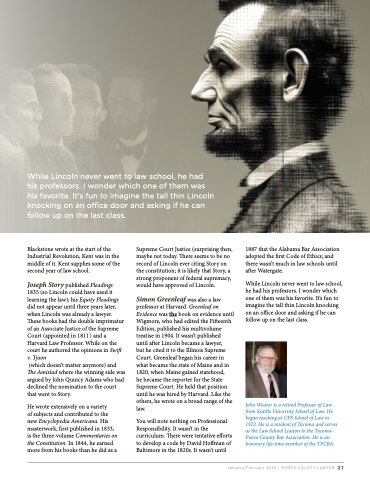
While Lincoln never went to law school, he had
his professors. I wonder which one of them was
his favorite. It’s fun to imagine the tall thin Lincoln
knocking on an office door and asking if he can
follow up on the last class.
Blackstone wrote at the start of the
Industrial Revolution, Kent was in the
middle of it. Kent supplies some of the
second year of law school.
Joseph Story published Pleadings
1835 (so Lincoln could have used it
learning the law); his Equity Pleadings
did not appear until three years later,
when Lincoln was already a lawyer.
These books had the double imprimatur
of an Associate Justice of the Supreme
Court (appointed in 1811 ) and a
Harvard Law Professor. While on the
court he authored the opinions in Swift
v. Tyson
(which doesn’t matter anymore) and
The Amistad where the winning side was
argued by John Quincy Adams who had
declined the nomination to the court
that went to Story.
He wrote extensively on a variety
of subjects and contributed to the
new Encyclopedia Americana. His
masterwork, first published in 1833,
is the three-volume Commentaries on
the Constitution. In 1844, he earned
more from his books than he did as a
Supreme Court Justice (surprising then,
maybe not today. There seems to be no
record of Lincoln ever citing Story on
the constitution; it is likely that Story, a
strong proponent of federal supremacy,
would have approved of Lincoln.
Simon Greenleaf was also a law
professor at Harvard. Greenleaf on
Evidence was the book on evidence until
Wigmore, who had edited the Fifteenth
Edition, published his multivolume
treatise in 1904. It wasn’t published
until after Lincoln became a lawyer,
but he cited it to the Illinois Supreme
Court. Greenleaf began his career in
what became the state of Maine and in
1820, when Maine gained statehood,
he became the reporter for the State
Supreme Court. He held that position
until he was hired by Harvard. Like the
others, he wrote on a broad range of the
law.
You will note nothing on Professional
Responsibility. It wasn’t in the
curriculum. There were tentative efforts
to develop a code by David Hoffman of
Baltimore in the 1820s. It wasn’t until
1887 that the Alabama Bar Association
adopted the first Code of Ethics; and
there wasn’t much in law schools until
after Watergate.
While Lincoln never went to law school,
he had his professors. I wonder which
one of them was his favorite. It’s fun to
imagine the tall thin Lincoln knocking
on an office door and asking if he can
follow up on the last class.
John Weaver is a retired Professor of Law
from Seattle University School of Law. He
began teaching at UPS School of Law in
1972. He is a resident of Tacoma and serves
as the Law School Liaison to the Tacoma-
Pierce County Bar Association. He is an
honorary life-time member of the TPCBA.
J a n u a r y / F e b r u a r y 2 0 2 6 | P I E R C E C O U N T Y L A W Y E R 2 1


