


Page 26 - CF Roundtable - Winter/Spring 2026
P. 26
FOCUS TOPIC: CF CLINICAL TRIALS By: Mel Kotlyar
WHY WE PARTICIPATE IN CF
CLINICAL TRIALS: A JOURNEY
OF HOPE AND DETERMINATION
As a kid, I didn’t have much of a say in my medical care—my
mom made most of the decisions for me. Living with cystic
fibrosis (CF) was challenging, but she was determined to
give me every chance at a better life. That meant enrolling
me in a few clinical trials. At the time, I didn’t fully grasp what
was happening; I was just along for the ride.
As I grew into young adulthood, my priorities shifted. Like
many others in their late teens and early twenties, I was busy
figuring out who I was and what I wanted from life. College,
work, friends, and adventures filled my days. Honestly, my
health wasn’t always at the forefront of my mind. For several
years, clinical trials—and even the idea of actively managing
my CF—weren’t on my radar. Then, I met my wife.
A Wake-Up Call
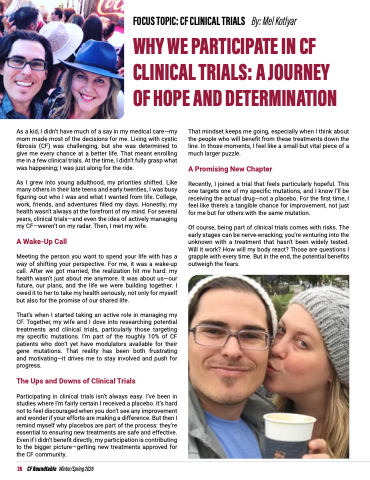
Meeting the person you want to spend your life with has a
way of shifting your perspective. For me, it was a wake-up
call. After we got married, the realization hit me hard: my
health wasn’t just about me anymore. It was about us—our
future, our plans, and the life we were building together. I
owed it to her to take my health seriously, not only for myself
but also for the promise of our shared life.
That’s when I started taking an active role in managing my
CF. Together, my wife and I dove into researching potential
treatments and clinical trials, particularly those targeting
my specific mutations. I’m part of the roughly 10% of CF
patients who don’t yet have modulators available for their
gene mutations. That reality has been both frustrating
and motivating—it drives me to stay involved and push for
progress.
The Ups and Downs of Clinical Trials
Participating in clinical trials isn’t always easy. I’ve been in
studies where I’m fairly certain I received a placebo. It’s hard
not to feel discouraged when you don’t see any improvement
and wonder if your efforts are making a difference. But then I
remind myself why placebos are part of the process: they’re
essential to ensuring new treatments are safe and effective.
Even if I didn’t benefit directly, my participation is contributing
to the bigger picture—getting new treatments approved for
the CF community.
That mindset keeps me going, especially when I think about
the people who will benefit from these treatments down the
line. In those moments, I feel like a small but vital piece of a
much larger puzzle.
A Promising New Chapter
Recently, I joined a trial that feels particularly hopeful. This
one targets one of my specific mutations, and I know I’ll be
receiving the actual drug—not a placebo. For the first time, I
feel like there’s a tangible chance for improvement, not just
for me but for others with the same mutation.
Of course, being part of clinical trials comes with risks. The
early stages can be nerve-wracking; you’re venturing into the
unknown with a treatment that hasn’t been widely tested.
Will it work? How will my body react? Those are questions I
grapple with every time. But in the end, the potential benefits
outweigh the fears.
26 CF Roundtable Winter/Spring 2026


