


Page 9 - AfrElec Week 03
P. 9
AfrElec
GAS-FIRED GENERATION AfrElec
reported that the Deepsea Stavanger was slated to remain at Block 11B/12B for nearly a full year. During that time, it said, the rig will drill up to three more wells.
Equity in the project is split between Total, with 45%; Qatar Petroleum, with 25%; CNR International (South Africa), with 20%, and Main Street 1549, a company in which Africa Energy owns a 49% stake, with 10%. The group’s
19,000-square km licence area lies in the Outeni- qua Basin in waters ranging from 200 to 1,800 metres deep.
“The Paddavissie Fairway in the south-west corner of the block includes the Brulpadda oil and gas discovery, as well as several large subma- rine fan prospects that have been significantly de-risked by the discovery and subsequent 3D seismic work,” Africa Energy noted.
Equatorial Guinea seeks Nigeria’s help in developing small refineries
E GUINEA
EQUATORIAL Guinea will work with Nigerian partners to build small-scale modular refiner- ies, in order to emulate a similar project already underway in Nigeria’s east Niger Delta Basin.
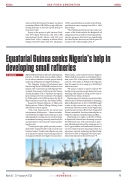
The Nigerian Contact Development and Monitoring Board (NCDMB) announced on January 19 it would team up with Nigeria’s Wal- tersmith Petroman to help Equatorial Guinea develop the plants. The co-operation was agreed uponduringasitevisitonJanuary18arranged by Waltersmith at its 5,000 barrel per day (bpd) Ibigwe refinery in Imo State, due online in May.
Equatorial Guinea’s Minister of Mines and Hydrocarbons Gabriel Mbaga Obiang Lima attended the event as a guest.
“I am truly impressed by the nature and advancement of this project ... I share our indus- try’s belief that it is high time for Africans to start refining and processing our own crude at home to maximise our energy security, create local jobs and add value to our economies,” Lima said dur- ing the event.
“Creating the right public-private partner- ship will be of great benefit to all countries and business leaders.” Small-scale refineries are seen as an attractive option for processing crude oil at marginal oilfields into higher-end products.
Waltersmith, a joint venture between Nigeria’s Waltersmith & Associates and Canada’s Petro- man, owns 70% of the project, while NCDMB controls a 30% stake on behalf of the Nigerian state. Its capacity is set to ramp up to 30,000 bpd within two years.
“We cannot continue to export crude oil. We should start processing our products and we are watching what Nigeria is doing and we want to replicatethem,”Limacontinued.
Nigeria expects to launch a second modular refinery, the 12,000 bpd Azikel hydro-skimming plant in Bayelsa State, in 2021. NCDMB bought a stake in the venture last year, to help with investment The state concern is also supporting another project in Cross River State. Equatorial Guinea, meanwhile, has less advanced plans to build two refineries on Bioko Island and Bata.
Walersmith won rights to the EG-23 block in Equatorial Guinea’s latest licensing round in November last year. At the ceremony, its chair- man Abdulrazaq Isah said the company saw “a lot of opportunities and similarities [between] our two countries and we are going to share our experience, capacity, technology and knowledge base that we have as Nigerians who have oper- atedinthisindustryinthelast50years.”
Week 03 23•January•2020 w w w. N E W S B A S E . c o m P9


