


Page 5 - AsianOil Week 50
P. 5
AsianOil
SOUTH ASIA AsianOil
In October, New Delhi eased the barrier to entry for those companies interested in setting up a retail fuel network, allowing the entry of non-oil and gas companies to acquire a fuel retailing licence. Prior to this, companies had needed to have invested at least INR20bn ($281.6mn) in either upstream, midstream or downstream projects before they were eligible to apply.
Parties interested in entering the retail sector will still need to have a minimum net worth of INR2.5bn ($35.2mn) to apply. Successful appli- cants are expected to set up at least 100 retail outlets, with 5% of the number to be located in remote areas.
While BP received a licence to set up and run 3,500 retail outlets in 2016, it has avoided enter- ing the space until now.
SOUTHEAST ASIA
Fitch: Singapore’s LNG imports to triple by 2028
PERFORMANCE
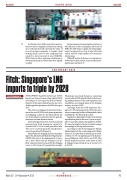
SINGAPORE’S liquefied natural gas (LNG) imports are forecast to more than triple by 2028, according to a new report by Fitch Solutions. Imports of the super-chilled fuel are also set to displace pipeline gas imports by 2026, the report said.
This comes as Singapore’s government pro- motes the use of LNG for both power generation and shipping, as part of a broader push for the use of natural gas to meet the country’s goals for emissions cuts and decarbonisation.
Indeed, Singapore’s power sector has already increased gas-fired generation capacity to account for 97% of its overall generation mix. The sector is predominantly anticipated to source its gas from LNG imports.
Meanwhile, the shipping industry is prepar- ing for the International Maritime Organisation (IMO) 2020 rules to be implemented on Janu- ary 1, 2020. These rules are seeking to cut sul- phur emissions from fuel used by the shipping sector to 0.5%, from 3.5% permitted currently.
While there are several obstacles to converting vessels to burn LNG instead of fuel oil, the loom- ing implementation of the new regulations has nonetheless encouraged many in the shipping industry to turn to LNG.
“Amongst Asia’s net LNG importers, Sin- gapore’s LNG uptake growth will be the most robust, surpassing the likes of Bangladesh, India and Pakistan,” the Fitch report stated.
Singapore is planning to build a new floating regasification plant in the next 10 years as it pre- pares to accommodate its rising imports of LNG. It is one of a number of Asian countries turning increasingly to floating infrastructure.
According to data from Singapore’s Energy Market Authority, the country imported 9.96mn tonnes of oil equivalent of natural gas in 2018, of which 71.4% was pipeline gas from Indone- sia and Malaysia, while 28.6% was LNG. This already marks an increase, as the share of LNG in Singapore’s gas demand was at around 11% in 2013.
Week 50 19•December•2019 w w w . N E W S B A S E . c o m P5


