Page 61 - Empowerment and Protection - Stories of Human Security
P. 61
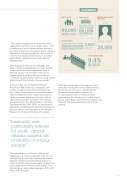
80,000 SINCE 2007
(HUMAN RIGHTS WATCH 2014)
ALLEGED ABUSES
DRUG CARTELS BRING IN $19 TO $29
9.4% IN 2012
(WORLD BANK 2014B)
Although several positive developments have taken place during the current administration, much remains to be done. Continued and systematic human rights violations, the ever-growing presence of violent criminal organisations, the emergence of civilian armed groups, and rampant government corruption and impunity still threaten human security in the country.
61
“The military response led to more fear and the suppression of activities in the public space. A lot of soldiers took over civilian positions related to law enforcement in the local government. Marines and soldiers started patrolling the streets and we witnessed an unprecedented increase in human rights abuses, including torture and enforced disappearances.”
Some groups have been more vulnerable than others, “[Enforced disappearance] victims belong
to the poorest and most marginalised strata of Mexican society.” An interviewee from the la Laguna region in northern Mexico comments, “insecurity was particularly intense for youth; armed attacks caused lots of deaths of young people.”
In 2012, newly elected President Enrique
Peña Nieto (PRI) promised a completely new strategy to address insecurity and violence in
the country, focusing more on crime prevention and reconstruction of the social tissue, and less
on the territorial deployment of police oficers and military and navy personnel. The strategy was formalised in the administration’s 'National Development Plan 2013-2018'; the government- opposition coordination mechanism known as the ‘Pact for Mexico’ and ultimately in the National Program for Crime and Violence Prevention.
”Insecurity was particularly intense for youth; armed attacks caused lots of deaths of young people.”
The announcement of the new strategy was applauded as a much needed shift from the one privileged by the previous Calderón government. National, regional and international policies to reduce both the demand and supply of drugs have increasingly been accused of having failed, with Mexican drug cartels today bringing in $19 to $29 billion USD annually.8
ALLEGED ABUSES BY SOLDIERS 5,600 AGAINST CIVILIANS, FROM JAN 2007
YOUTH UNEMPLOYMENT
PEOPLE KILLED
DRUG CARTELS
DEPORTED, DISAPPEARED OR MISSING
MISSING
26,000
(HUMAN RIGHTS WATCH 2014)
OPEN INVESTIGATIONS: TO MID-2013 (HUMAN RIGHTS WATCH 2014)
IN NUMBERS
BILLION USD ANNUALLY (CNN WORLD 2014)