Page 65 - Empowerment and Protection - Stories of Human Security
P. 65
Citizens and representatives from the three levels of government participated in Mesa de Seguridad.
It was a true multi-stakeholder dialogue. The basic assumption was that civil society and government acting together could better identify the priority areas, generate and implement concrete proposals, and follow-up and evaluate the results of those proposals. This committee was so effective in generating trust and carrying out different strategies that it is still in place, even though the Todos somos Juárez initiative oficially ended in 2012.
Today, the Mesa de Seguridad has several subcommittees that address access to justice, immediate response to threats, violent theft, human rights, and performance indicators. All three levels of government continue to participate in the Mesa de Seguridad.
Accomplishments of Mesa de Seguridad
Mesa de Seguridad has fostered sincere dialogue between citizens and authorities and it has contributed to developing trust among different stakeholders from civil society and between them and the authorities. It has also fostered collaboration between different levels of government and different authorities.
Thanks to the pressure of the Mesa de Seguridad, the federal government had to change its strategy from 'territorial control' – the massive deployment of soldiers, marines and police oficers – to strengthening the investigation and intelligence capacities of the authorities. Through the Mesa
de Seguridad we citizens were able to tell the president that we did not want 5,000 more police or army oficials, but 200 public prosecutors.
In the end he accepted our request and sent
40 public prosecutors to strengthen the state attorney’s ofice (he told us he did not have 200). He also sent an anti-kidnapping group and an anti- extortion group.
Mesa de Seguridad has become an informal communication channel between citizens and public oficials. It has brought the government closer to ordinary citizens. It has also contributed to transparency and accountability, because the citizens that participate in the subcommittees and the plenary sessions can evaluate what the authorities are doing.
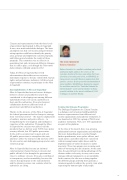
THe civic MeDiaToR Dolores González
Dolores González is a conlict resolution professional and human rights activist. She serves as the executive director of Services and advice for Peace (Servicios y asesoría para la Paz, or SeRaPaZ) an independent, non-proit Mexican organisation that provides services for the peaceful transformation of social conlicts. SeRaPaZ was founded to support the mediation work of the “comisión nacional de intermediación” a civil society initiative to ind a peaceful solution to the armed rebellion of 1994
in chiapas in southern Mexico.
Forming the Dialogue Programme
The Dialogue Programme on Citizen Security
is a dialogue and consensus-building platform between representatives from different civil society organisations and academic institutions. It was launched in 2009 by a group of NGOs and academic institutions. Now, over 160 organisations are part of this platform.
At the time of the launch, there was growing polarisation between organisations and individuals that were demanding more security through harsher punishments, more police oficers, and 'quick justice,' and others that were concerned
with increasing human rights abuses and the implementation of violent measures to tackle insecurity. These two groups were accusing each other of worsening the dire situation. At the same time, the government was taking advantage of the division within civil society to carry out its own strategy without transparency or accountability.
In this context, the idea was to bring together
the different groups and help them generate a common agenda to address the security crisis while respecting the human rights of all people.
65