


Page 12 - Sites_March 16
P. 12
EMPTY NESTERS continued
They really didn’t want to downsize, so they rented single-family homes. Others are renting smaller homes to stay in their neighborhood.
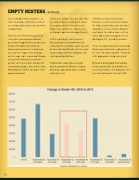
Still, there are 100,000 new apartment renters per year among the Boomer generation, though they’re spread across markets throughout the nation. So
while property planners certainly need
to account for empty-nester demand, which is expected to remain high through at least 2016, Millennials remain the primary renter generation, and much of the planning should center on that cohort; Millennials are still the core driver of the apartment market.
On the other hand, the fact that older folks are surprising pre-leasing agents comes as a surprise in itself. After all, recent studies have shown that empty-nesters are taking to apartment living pretty well.
A 2013 report by the Joint Center for Housing Studies at Harvard University estimated that 2.2 million seniors who will be 65 or older by 2023 will enter the rental market, about half of the total projected renter growth by that time.
A Fannie Mae study, however, found that the proportion of Boomers living in detached, single-family homes is down only 0.3 percent.
A CBS News report featured John McIlwain, a senior fellow for housing at the Urban Land Institute, who not only is studying the senior renting trend, but is also living it. He sold his house in Chevy Chase, Md., to move to Dupont Circle in Washington, D.C., he told the network.
“There is a signi cant portion of the Baby Boomer generation that is opting to go to the cities,” McIlwain told CBS. “I think this is the beginning of a long-term trend.”
McIlwain acknowledged that hard data
on the trend are dif cult to  nd, but he’s seen visual evidence of it in about 40 cities he’s visited in the past few years, CBS
12


