


Page 29 - April 2018 Disruption Report Flip Book
P. 29
FEDERAL GOVERNMENT JAANPURAIRLY20210818
and policy and improve the likelihood that integrating and institutionalizing its incredible potential across the public sector will be successful.
Challenges to Overcome
Enabling Blockchain Innovation in the U.S. Federal Government
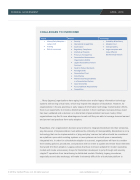
Blockchain has the potential to transform both the effectiveness and efficiency of the public sector, but that potential is not without its challenges. The following are a few of the key challenges to overcome
CHALLENGES TO OVERCOME
when considering the impact of blockchain on people, process, and technology in the public sector:
People
Process
Technology
Infancy/Early Adoption— culture shift
Training
Risks to consumers
Security
Operational & Legal Risks
Governance
Regulatory Compliance
Intellectual Property
Privacy vs Transparency
Decentralized Autonomous
Organizations (DAOs)
Legal Enforceability of Smart
Contracts
Need for Robust Standards
Paradigm Shifts
Decentralized Trust
Data Sharing
Maintenance Responsibilities
in a Decentralized System
Quasi-Anonymity
Accountability & Responsibility
Competition
Scalability & Resiliency
Adoption Cost
Interoperability
Large ecosystem with
many different blockchains/protocols
What Does the Shift to Blockchain Mean for the U.S. Federal Government?
... Many [agency] organizations have aging infrastructure and/or legacy information technology
As more organizations adopt blockchain and specific applications are developed, implemented, and
systems still serving critical roles, which may impede the adoption of blockchain. However, for
scaled, additional risks will certainly reveal themselves. However, these risks and their potential impact
organizations in the pre-planning or early stages of information technology modernization efforts,
to the workplace should not take away from the benefits of blockchain adoption.
there is an opportunity to include a blockchain solution in their roadmaps now (assuming a need
One of the greatest obstacles at any level of government will be the evolution of operations necessary
has been validated and a decision on a blockchain implementation has been made). Other
to achieve the many benefits offered by blockchain technologies. Blockchain represents a fundamental
organizations may find it more advantageous to wait until they are able to leverage lessons learned
change in the way an organization does business and a departure from the incremental improvements
and proven best practices from early adopters.
American Council for Technology-Industry Advisory Council (ACT-IAC)
3040 Williams Drive, Suite 500, Fairfax, VA 22031
Regardless of an organization’s decision around when to integrate blockchain into their enterprise,
www.actiac.org ● (p) (703) 208.4800 (f) ● (703) 208.4805
any discussion of implementation must address the criticality of interoperability. Blockchain is not a
Advancing Government Through Collaboration, Education and Action Page 19 technology that can be implemented in a ‘plug-and-play’ manner but rather should be considered
as a platform upon which existing systems or new systems can be built upon or seamlessly integrated into. In order for a blockchain adoption to succeed, organizations will have to consider their existing policies, procedures, and practices with an intent to update and revise those elements that would limit their adoption. Legacy policies that have not been updated for modern operating models will create unnecessary hoops for blockchain developers to jump through and severely cripple IT operations from transitioning to distributed models. Similarly, legacy procedures, especially around data exchange, will make it extremely difficult for a blockchain platform to
© 2018 by Canfield Press, LLC. All rights reserved. www.canfieldpress.com 29


