


Page 18 - DUT 2025 SFSA Report
P. 18
 DUT’s Dr Vimla Paul to Showcase her Innovative
Biodegradable Sanitary Pad
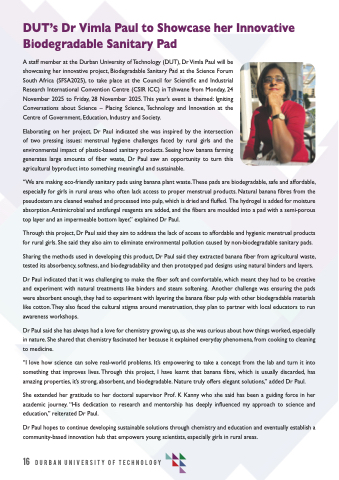
A staff member at the Durban University of Technology (DUT), Dr Vimla Paul will be showcasing her innovative project, Biodegradable Sanitary Pad at the Science Forum South Africa (SFSA2025), to take place at the Council for Scientific and Industrial Research International Convention Centre (CSIR ICC) in Tshwane from Monday, 24 November 2025 to Friday, 28 November 2025. This year’s event is themed: Igniting Conversations about Science – Placing Science, Technology and Innovation at the Centre of Government, Education, Industry and Society.
Elaborating on her project, Dr Paul indicated she was inspired by the intersection of two pressing issues: menstrual hygiene challenges faced by rural girls and the environmental impact of plastic-based sanitary products. Seeing how banana farming generates large amounts of fiber waste, Dr Paul saw an opportunity to turn this agricultural byproduct into something meaningful and sustainable.
“We are making eco-friendly sanitary pads using banana plant waste.These pads are biodegradable, safe and affordable, especially for girls in rural areas who often lack access to proper menstrual products. Natural banana fibres from the pseudostem are cleaned washed and processed into pulp, which is dried and fluffed. The hydrogel is added for moisture absorption. Antimicrobial and antifungal reagents are added, and the fibers are moulded into a pad with a semi-porous top layer and an impermeable bottom layer,” explained Dr Paul.
Through this project, Dr Paul said they aim to address the lack of access to affordable and hygienic menstrual products for rural girls. She said they also aim to eliminate environmental pollution caused by non-biodegradable sanitary pads.
Sharing the methods used in developing this product, Dr Paul said they extracted banana fiber from agricultural waste, tested its absorbency, softness, and biodegradability and then prototyped pad designs using natural binders and layers.
Dr Paul indicated that it was challenging to make the fiber soft and comfortable, which meant they had to be creative and experiment with natural treatments like binders and steam softening. Another challenge was ensuring the pads were absorbent enough, they had to experiment with layering the banana fiber pulp with other biodegradable materials like cotton.They also faced the cultural stigma around menstruation, they plan to partner with local educators to run awareness workshops.
Dr Paul said she has always had a love for chemistry growing up, as she was curious about how things worked, especially in nature. She shared that chemistry fascinated her because it explained everyday phenomena, from cooking to cleaning to medicine.
“I love how science can solve real-world problems. It’s empowering to take a concept from the lab and turn it into something that improves lives. Through this project, I have learnt that banana fibre, which is usually discarded, has amazing properties, it’s strong, absorbent, and biodegradable. Nature truly offers elegant solutions,” added Dr Paul.
She extended her gratitude to her doctoral supervisor Prof. K Kanny who she said has been a guiding force in her academic journey. “His dedication to research and mentorship has deeply influenced my approach to science and education,” reiterated Dr Paul.
Dr Paul hopes to continue developing sustainable solutions through chemistry and education and eventually establish a community-based innovation hub that empowers young scientists, especially girls in rural areas.
 16 DURBAN UNIVERSITY OF TECHNOLOGY


