


Page 3 - Aerotech News and Review – December 5, 2025
P. 3
   CONTACT: Editorial Staff at 334-718-3509 • E-Mail: editor@aerotechnews.com
AEROTECH NEWS December 5, 2025 3 www.aerotechnews.com Facebook.com/AerotechNewsandReview
DCMA champions ‘Drone Dominance’ objectives
  by Thomas Perry
DCMA Public Affairs
EDWARDS AIR FORCE BASE, Calif. — The Defense Contract Manage- ment Agency recently launched its latest warfighter support mission establishing Special Programs Unmanned Systems- Experimental, or US-X, to align with a War Department acquisition priority of “Unleashing U.S. Military Drone Domi- nance.”
“DCMA Unmanned Systems is about precision, speed and an unsentimental approach to the next era of defense ac- quisition,” said Sonya Ebright, DCMA’s acting director. “It’s our first integration of mainstream and Special Programs. It’s off-leash in some ways, expected to go faster, be more flexible, less risk-adverse and draw the map for future programs to follow. It’s our racecar and a test bed, and we’ll use the things that work best to make our entire fleet better.”
A key aspect of this organizational focus is managing the Department of War’s Blue List program, a multi-tiered operational unit and defense industrial base support network designed to drive rapid development, vigorous production and efficient delivery of unmanned air- craft systems and components.
“Secretary of War Pete Hegseth has directed us to ‘unleash the combined po- tential of American manufacturing and warfighter ingenuity’ through the Blue List, a completely new type of marketplace that will push the small drone competitive space,” said Ebright. “This US-X managed list will incentivize industry to lower costs and encourage innovation. More importantly, it will get critical drones and components into warfighter hands as fast as Amazon delivers goods to your home.”
To accelerate the commercialization of drone technologies, US-X plans to cham- pion industrial access by simplifying the application and onboarding process for American companies.
“The Blue List onboarding process is still being prototyped, but the concept is straightforward: focus on components rather than full systems,” said Col. Dustin Thomas, DCMA US-X commander. “To meet the secretary of war’s intent for faster, easier onboarding, we designed a process where a military unit sponsors a desired (small) UAS, delivers the aircraft for in- spection, and every component is logged against the Blue List.”
If all components are already approved, a certification is triggered, and the product is added to the Blue List program.
“If we find a component not yet on the list, only that part goes to deeper review with a recognized assessor, while we also identify alternative components already
Air Force photograph by Lindsey Iniguez
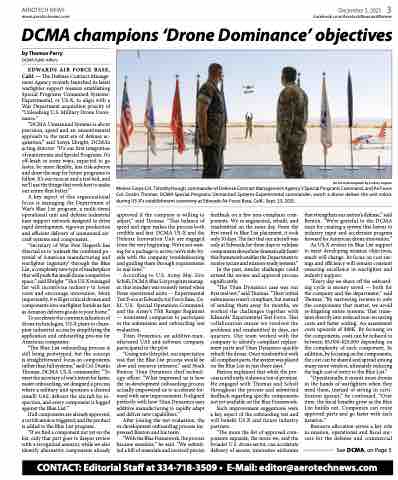
Marine Corps Col. Timothy Hough, commander of Defense Contract Management Agency’s Special Programs Command, and Air Force Col. Dustin Thomas, DCMA Special Programs Unmanned Systems-Experimental commander, watch a drone deliver the unit colors during US-X’s establishment ceremony at Edwards Air Force Base, Calif., Sept. 23, 2025.
  approved if the company is willing to adjust,” said Thomas. “That balance of speed and rigor makes the process both credible and fast. DCMA US-X and the Defense Innovation Unit are engaged from the very beginning. We’re not wait- ing for a package to arrive; we’re side-by- side with the company troubleshooting and guiding them through requirements in real time.”
According to U.S. Army Maj. Eric Scholl, DCMA Blue List program manag- er, this mindset was recently tested when three operational units — Experimental Test Force at Edwards Air Force Base, Ca- lif., U.S. Special Operations Command, and the Army’s 75th Ranger Regiment — nominated companies to participate in the submission and onboarding test evaluation.
Titan Dynamics, an additive-man- ufactured UAS and software company, participated in the pilot.
“Going into this pilot, our expectation was that the Blue List process would be slow and resource-intensive,” said Noah Benton, Titan Dynamics chief technol- ogy officer. “What impressed us is how the in-development onboarding process actually empowered us to accelerate for- ward with new improvements. It aligned perfectly with how Titan Dynamics uses additive manufacturing to rapidly adapt and deliver new capabilities.”
After joining the test evaluation, the in-development onboarding process im- pressed Benton and his team.
“With the Blue Framework, the process became seamless,” he said. “We submit- ted a bill of materials and received precise
feedback on a few non-compliant com- ponents. We re-engineered, rebuilt, and resubmitted on the same day. From the first email to Blue List placement, it took only 10 days. The fact that our aircraft was only at Edwards for three days to validate components shows how dramatically faster this framework enables the Department to receive secure and mission-ready systems.”
In the past, similar challenges could extend the review and approval process significantly.
“The Titan Dynamics case was our first real test,” said Thomas. “Their initial submission wasn’t compliant, but instead of sending them away for months, we worked the challenges together with Edwards’ Experimental Test Force. That collaboration meant we resolved the problems and resubmitted in days, not quarters. Our team worked with the company to identify compliant replace- ment parts and Titan Dynamics quickly rebuilt the drone. Once resubmitted with all compliant parts, the system was placed on the Blue List in just three days.”
Benton explained that while the pro- cess is still early, it shows a ton of promise. He engaged with Thomas and Scholl throughout the process and submitted feedback regarding specific components not yet available on the Blue Framework.
Such improvement suggestions were a key aspect of the onboarding test and will benefit US-X and future industry partners.
“The more the list of approved com- ponents expands, the more we, and the broader U.S. drone sector, can accelerate delivery of secure, innovative airframes
that strengthen our nation’s defense,” said Benton. “We’re grateful to the DCMA team for creating a system that listens to industry input and accelerates progress forward for American drone innovation.”
As US-X evolves its Blue List support to meet developing mission objectives, much will change. Its focus on cost sav- ings and efficiency will remain constant ensuring excellence in warfighter and industry support.
“Every day we shave off the onboard- ing cycle is money saved — both for the company and the department,” said Thomas. “By narrowing reviews to only the components that matter, we avoid re-litigating entire systems. That trans- lates directly into reduced non-recurring costs and faster scaling. An assessment costs upwards of $80K. By focusing on the components, costs can be reduced to between $5,000-$20,000 depending on the complexity of each component. In addition, by focusing on the components, the cost can be shared and spread among many more vendors, ultimately reducing the high cost of entry to the Blue List.”
“Operationally, it means more drones in the hands of warfighters when they need them, instead of sitting in certi- fication queues,” he continued. “Over time, the fiscal benefits grow as the Blue List builds out. Companies can reuse approved parts and go faster with each iteration.”
Resource allocation serves a key role in mission, operational and fiscal suc- cess for the defense and commercial
See DCMA, on Page 5


