


Page 12 - Desert Lightning News, So. AZ Edition, Oct. 6 2017
P. 12
12 October 2017 Desert Lightning News www.aerotechnews.com/davis-monthanafb
Facebook.com/DesertLightningNews
Story and photos by Airman 1st Class MICHAEL BEYER
355th Fighter Wing Public Affairs
Once a month, Survival, Evasion, Resistance and Escape specialists from the 355th Operations Support Squadron, conduct water survival training for aircrew members and pilots.
“They’re being put in situations that if their aircraft goes down, and they have to bail out, they will have the skills to survive,” said Staff Sgt. Seth Reab, 355th Opera- tional Support Squadron SERE NCO in charge.
The course begins with an academic classroom les- son, where SERE instructors inform the students of the hazards, risks and injuries associated with open water survival, and how to combat and treat them.
“The way we like to teach it is, take a look around you, and see what’s going to kill you first,” Reab said.
From extreme weather conditions to dangerous animals, there are a variety of threats that can cause injury and death in open water.
“Is it going to be the extreme cold, where you need to insulate your body and stay dry using the limited equip- ment you have so you can fend off hypothermia and cold injuries?,” Reab said. “Or is it going to be the heat; is it 110 degrees and you have nothing to cover yourself up with and you’re going to die of dehydration, heat exhaus- tion or heat stroke?”
Extreme temperatures are not the only environmental risks that aircrew members must brace for in open water survival, they must also take into account dangerous marine life and what to do if they get attacked.
“We teach students what to do if they get bit by a shark versus a barracuda or a snake,” Reab said.
One of the most difficult aspects of water survival isn’t heat or predators; it’s the limited supplies that the crashed aircrew member will have to work with, and not knowing how long they have to last until rescue arrives. SERE instructors heavily stress equipment preservation during the course.
“What we hit on in our course is you have limited equip- ment and you need to know how to use your equipment to get rescued,” Reab said.
As teachers, SERE instructors hope to make the class engaging so that aircrew members take away as much information as possible, because the skills they learn will be used in the future.
“I like to teach my students with a certain passion that makes them want to learn,” Reab said, “because these skills have been proven to save peoples’ lives.”
Despite the valuable tools that SERE specialists provide to their students, there is one skill they can’t teach.
“The most important skill that I want to teach but can’t teach is the ability of the student to have the will to survive,” said Staff Sgt. Joseph Collett, 355th OSS SERE specialist. “That’s something you can’t teach. The student either has it or he doesn’t.”
Still, the skills learned at the water survival course are imperative, and SERE instructors often see the real-world impact of their instruction later in life.
“I’ve had multiple students that have bailed out of aircraft and they said, ‘Your lesson came back to me, and I knew exactly what to do. We went through it so many times and it was explained in such a way that I knew instinctively what to do, and I didn’t even think about it,’” Reab said.
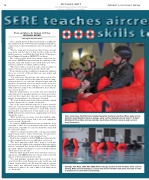
Capt. Justin Isles, 43rd Electronic Combat Squadron electronics warfare officer, helps aircrew members board floatation devices during a water survival training exercise Sept. 11 at Davis- Monthan Air Force Base. Aircrew members must take a refresher course in water survival every three years.
Staff Sgt. Seth Reab, 355th OSS SERE NCO in charge, teaches aircrew members water survival training. Water survival training is a course that aircrew members and pilots must take in order to prepare for an open-water crash landing.


