


Page 18 - Desert Lightning News, So. AZ Edition, Oct. 6 2017
P. 18
18 October 2017 Desert Lightning News www.aerotechnews.com/davis-monthanafb
Facebook.com/DesertLightningNews
Army camp built to protect early settlers
Fort Huachuca is a product of the Indian Wars of the 1870s and 1880s. In February 1877, Col. August Kautz, commander of the Department of Arizona, ordered that a camp be established in the Huachuca Moun- tains. This camp would offer protection to settlers and travel routes in southeastern Arizona while simultaneously blocking the traditional Apache escape routes through the San Pedro and Santa Cruz valleys to sanctuary in Mexico. A temporary camp was established at the post’s current location on March 3, 1877, by Capt. Samuel Marmad- uke Whitside with two companies of the 6th Cavalry. The site was selected because it had fresh running water, an abundance of trees, excellent observation in three directions, and protective high ground for security against Apache tactical methods. Camp Huachuca was redesignated a fort in 1882.
In 1886, Gen. Nelson Miles designated Fort Huachuca as his advance headquarters and forward supply base for the Geronimo campaign. Geronimo’s surrender in August
1886 practically ended the Apache danger in southern Arizona. The Army closed more than 50 camps and forts in the territory, but Fort Huachuca was retained because of continuing border troubles involving renegade Indians, Mexican bandits, and American outlaws and freebooters.
In 1913, the 10th Cavalry “Buffalo Sol- diers” arrived and remained almost 20 years. The 10th Cavalry joined Gen. John J. Pershing in the 1916 expedition into Mexico and, during World War I, it was assigned the mission of guarding the United States- Mexico border.
By 1933, the 25th Infantry Regiment had replaced the 10th Cavalry as the main combat unit for the fort. The 25th, in turn, was absorbed by the 93rd Infantry Divi- sion during World War II. When the 93rd departed for the Pacific in 1943, the 92nd Infantry Division arrived at the fort for training and subsequent assignment to the European Theater. During the war years, the troop strength reached 30,000 men at the fort, which in the 1930s had been de-
scribed as suitable for a brigade-sized unit of about 10,000 men.
At war’s end, the fort was declared sur- plus and transferred to the State of Arizona. It was reactivated during the Korean War by the Army Engineers.
A new era began in 1954 when control passed to the Chief Signal Officer, who found the area and climate ideal for testing electronic and communications equipment. The importance of the fort in the national defense picture grew steadily from that moment. In 1967, Fort Huachuca became the headquarters of the U.S. Army Strategic Communications Command.
Then, in 1971, the post became the home of the U.S. Army Intelligence Center and School, bringing with it the School Brigade.
The Strategic Communications Com- mand became the U.S. Army Communi- cations Command in 1973, subsequently changing to the U.S. Army Information Systems Command in 1984.
In October 1990, the post changed hands with the U.S. Army Training and Doctrine
Fort Huachuca History
Command, which became the new host com- mand; the U.S. Army Intelligence Center and Fort Huachuca now operates the post.
Today, Fort Huachuca is a major military installation in Arizona, and one of promi- nence throughout the Southwest.
Courtesy of Huachuca.army.mil
Evolution of adaptive sports improves experience
by Staff Sgt. ALEXX PONS
Air Force Personnel Center Public Affairs
TORONTO — With the event coming to a close, thousands around the world turned their attention toward the 2017 Invictus Games, witnessing feats of incredible talent and hearing truly inspiring stories from world-class athletes.
The Invictus Games, established by Prince Harry of Wales in 2014, brought together wounded and injured military members and veterans from 17 nations to compete across 12 adaptive sporting events. More than 550 wounded, ill or injured athletes journeyed to Toronto for the com- petition, and military leaders did not trail far behind to demonstrate their continued support of these heroes.
“Being invited to the Invictus Games is a tremendous honor,” said Lt. Gen. Gina Grosso, Air Force Deputy Chief of Staff for Manpower and Personnel Services. “Rec- ognizing these incredible Airmen, Coast Guardsmen, Marines, Sailors and Soldiers representing the United States is truly humbling. We are letting them know how impactful what they are doing is for our na- tion, and that we stand firmly behind them, support them and believe in them.
“These games are incredibly fun to watch and you can feel how much energy is packed into these venues; but for those of us rep- resenting leadership within the Defense Department, we are also here to learn how to continue moving with adaptive sports programs and continuously improve our support for wounded warriors.”
Officials with the DoD announced in July that the Air Force would host the 2018 DoD Warrior Games at the U.S. Air Force Academy in Colorado Springs, Colorado, June 2018. Turning focus from the games to overarching program initiatives, Grosso
spoke about the Air Force Wounded War- rior Program, which is functionally aligned under the Air Force Warrior and Survivor Care Division and operationally managed by the Air Force Personnel Center.
“The testimonials we continue to hear from athletes who participate with the program and who have competed in previ- ous years, or are competing now for the first time, shows us that the work we are doing has value and impact,” Grosso said. “Hearing people say how this program saved their life - the connection between adaptive sports and recovery has become in- creasingly evident. As military leaders, we aspire to have those who have served, and are still serving, to maintain that ability to thrive - especially those who have suffered from catastrophic injuries. Simply put, it is incredibly clear to me how instrumental these programs are in the recovery process for our nation’s warriors and their families.”
During her time here, Grosso had lunch with members of Team U.S. where attend- ees were ready to offer suggestions for next year’s competitions. “Hearing their ideas for the evolution of the program was outstanding,” she said. “They want to see more of the adaptive sports featured here, at the 2018 Warrior Games - things like powerlifting, wheelchair rugby and wheel- chair tennis. They also suggested that every base have adaptive sports teams, which they believe would normalize the concept of adaptive sports. As a leader, it is difficult not to see the value in concepts like that; things that would foster trust, teamwork and cohesion. The question then becomes how to make ideas like that a standard practice across an entire service branch.”
Grosso acknowledged that type of growth can take time, but echoed sentiments shared by program participants.
“Our goal is to consistently evolve and outperform ourselves,” Grosso said.
Courtesy photo
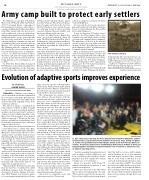
Lt. Gen. Gina Grosso (far left), Air Force Deputy Chief of Staff for Manpower and Per- sonnel Services, stands with several members of Team U.S. Sept. 29 and Joe Biden Jr., former vice president of the United States, kneels at the 2017 Invictus Games in Toronto. The Invictus Games were established by Prince Harry of Wales in 2014, and brought together wounded and injured veterans from 17 nations to compete across 12 adaptive sporting events.
“Leaders managing these programs need to be as adaptive as these athletes are, and I can certainly speak for Air Force leader- ship when I say how committed we remain to taking care of every Airman.”
Grosso was proud to watch Team U.S. dominate throughout the portions of com- petition she witnessed.
“There is no other way to describe what I have seen here beyond inspiring,” she said. “This really does put life into perspective. You see these athletes persevering despite
what they had to overcome, and it reminds us how fortunate we are to have amazing men and women of this caliber serving with us. I also want to add that it is no easy task assisting people through a crisis, so to my team down at AFPC, I say thank you for the incredible work you do in help- ing our wounded, ill and injured Airmen. It is reassuring to know that our members have the most dedicated staff working with them as they navigate through their road to recovery.”


