


Page 16 - Aerotech News and Review Veterans Day Special Edition – November 7th, 2025
P. 16
16 November 7, 2025 Aerotech News www.aerotechnews.com
Facebook.com/AerotechNewsandReview
   Veterans Day anD armistice Day in an american Family: section 18, graVe 1345
by Dennis Anderson
special to Aerotech News
ARLINGTON NATIONAL CEM- ETERY — Our kinsman, Joseph Otto Turley, was 24 years old when he was shot on the last day of World War I, one of hundreds dying in the final hours of the Great War before the guns went silent.
The former football player and student body president at Auburn High School in Washington state had come so far, serv- ing on a machine gun team in three of the bloodiest battles of history’s bloodiest war to date.
He had survived the charge at Soissons, the bloody ascent at Blanc Mont, and America’s biggest battle in World War I, the Meuse-Argonne campaign. Unless you knew a Doughboy or a Marine, or had one in family, these battles have faded into the mists of time.
Otto Turley had come so far, and would fall a few hundred yards short of the fin- ish line.
Nov. 11, 1918, was the final day of what was up to that time history’s biggest and
most lethal war, that war ending between the Allies and the Central Powers led by Germany on the 11th hour, of the 11th day of the 11th month.
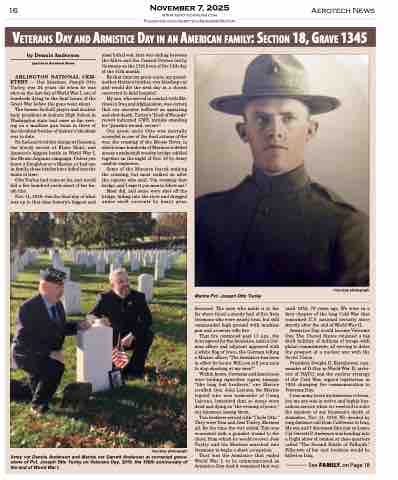
By that time my great uncle, my grand- mother Hattie’s brother, was bleeding out and would die the next day in a church converted to field hospital.
My son, who served in combat with Ma- rines in Iraq and Afghanistan, was certain that our ancestor suffered an agonizing and slow death. Turley’s “Died of Wounds” record indicated GWS, initials standing for “gunshot wound, severe.”
Our great uncle Otto was mortally wounded in one of the final actions of the war, the crossing of the Meuse River, in which some hundreds of Marines wobbled across a makeshift wooden bridge cobbled together on the night of Nov. 10 by Army combat engineers.
Some of the Marines feared making the crossing, but most walked on after the captain who said, “I’m crossing that bridge, and I expect you men to follow me.”
Most did, and some were shot off the bridge, falling into the river and dragged under swift currents by heavy gear,
    Army vet Dennis Anderson and Marine vet Garrett Anderson at corrected grave- stone of Pvt. Joseph Otto Turley on Veterans Day, 2018, the 100th anniversary of the end of World War I.
Courtesy photograph
Marine Pvt. Joseph Otto Turley
drowned. The ones who made it to the far shore faced a steady hail of fire from Germans who were nearly beat, but still commanded high ground with machine gun and accurate rifle fire.
That fire continued past 11 a.m., the hour agreed for the Armistice, until a Ger- man officer and adjutant appeared with a white flag of truce, the German telling a Marine officer, “The Armistice has been in effect for hours. Will you tell your men to stop shooting at my men?”
Within hours, Germans and Americans were trading cigarettes, cigars, sausage “like long lost brothers,” one Marine recalled. Gen. John Lejeune, the Marine legend who was namesake of Camp Lejeune, lamented that so many were dead and dying on “the evening of peace,” our kinsman among them.
Two brothers served with “Uncle Otto.” They were Tom and Jess Turley, Marines all. By the time the war ended, Tom was evacuated with a gunshot wound to the chest, from which he would recover. Jess Turley and his Marines marched into Germany to begin a short occupation
That was the Armistice that ended World War I, to be commemorated as Armistice Day. And it remained that way
Courtesy photograph
until 1954, 70 years ago. We were in a fiery chapter of the long Cold War that consumed U.S. national security since shortly after the end of World War II.
Armistice Day would become Veterans Day. The United States retained a big draft military of millions of troops with global commitments, all serving to deter the prospect of a nuclear war with the Soviet Union.
President Dwight D. Eisenhower, com- mander of D-Day in World War II, archi- tect of NATO, and the nuclear strategy of the Cold War, signed legislation in 1954 changing the commemoration to Veterans Day.
I was many years an American veteran, but my son was in active and highly haz- ardous service when we resolved to solve the mystery of our kinsman’s death at Armistice, Nov. 11, 1918. We decided by long distance call from California to Iraq. My son and I discussed this just as Lance Cpl Garrett P. Anderson was heading into a fright show of combat at close quarters called “The Second Battle of Fallujah.” Fifty-two of his unit brothers would be killed in Iraq.
See FAMILY, on Page 18


