


Page 24 - Aerotech News and Review Veterans Day Special Edition – November 7th, 2025
P. 24
24 November 7, 2025 Aerotech News www.aerotechnews.com
Facebook.com/AerotechNewsandReview
High Desert Hangar Stories
Flyover tradition dates to end of World War I, 1918
  by Bob Alvis
special to Aerotech News
Veterans Day weekend has been celebrated for many years. We find that date on our calendars every November as we take the time to remember the men and women who serve in uniform and pay homage to their service and sacrifice.
But many may not realize that the tradition of honoring our men and women happens on weekends and special events all year round in a tradition that goes back to World War I.
Ah yes, the military flyover that graces the skies at sporting events warms the hearts of patriots but drives many crazy. They look at it as the militarization of many of our sporting events. Nothing could be farther from the truth; in reality, it’s just a smaller version of Veterans Day year-round.
So where did the flyover tradi- tion really start and what were the conditions and events that inspired that first flyover?
Well, let’s look back at the end of World War I.
World War I fighting ended with the Armistice that called for hostili- ties to end on the eleventh hour on the eleventh day of the eleventh month: Nov. 11. The formal end came with the Treaty of Versailles on June 28, 1919, and became ef- fective on Jan. 10, 1920.
As the war was winding down, Americans turned their attention to baseball — specifically the World Series, considered a special event as America was dealing with the losses and horrors of the “War to End all Wars.” To help heal our na- tion, some felt a gesture to salute the men and women of World War I would be a nice addition to cel- ebrate America’s pastime.
The World Series that year was between the Boston Red Sox and Chicago Cubs. On Sept. 5, 1918,
Army photograph
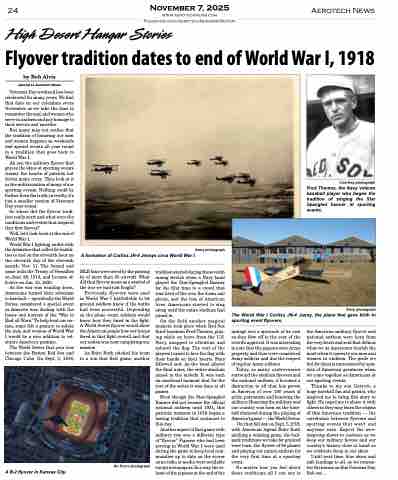
A formation of Curtiss JN-4 Jennys circa World War I.
Courtesy photograph
Fred Thomas, the Navy veteran baseball player who began the tradition of singing the Star Spangled banner at sporting events.
Army photograph
The World War I Curtiss JN-4 Jenny, the plane that gave birth to sporting event flyovers.
        A B-2 flyover in Kansas City.
MLB fans were awed by the passing by of more than 60 aircraft. What did that flyover mean as a symbol of the war we had just fought?
Previously, flyovers were used in World War I battlefields to let ground soldiers know if the battle had been successful. Depending on the plane count, soldiers would know how they fared in the fight. A World Series flyover would show the American people how our troops fared in that fight overall and that our nation was near completing our mission.
As Babe Ruth pitched his team to a win that first game, another
tradition started during the seventh inning stretch when a Navy band played the Star-Spangled Banner for the first time to a crowd that was tired of the war, the doom and gloom, and the loss of American lives. Americans started to sing along until the entire stadium had joined in.
On the field another magical moment took place when Red Sox third baseman Fred Thomas, play- ing while on leave from the U.S. Navy, snapped to attention and saluted the flag. The rest of the players turned to face the flag with their hands on their hearts. Fans followed suit. As the band played the final notes, the entire stadium joined in the melody. It was such an emotional moment that for the rest of the series it was done at all games.
Even though the Star-Spangled Banner did not become the official national anthem until 1931, this patriotic moment in 1918 began a lasting tradition that continues to this day.
Another aspect of that game with military ties was a different type of “flyover.” Pigeons who had been serving in World War I were used during the game to keep local com- munities up to date on the scores as no radio or media were available except newspapers. In a way, the re- lease of the pigeons at the end of the
innings was a spectacle of its own as they flew off to the roar of the crowd’s approval. It was interesting to note that the pigeons were Army property and thus were considered Army soldiers and due the respect of regular Army soldiers.
Today, so many controversies surround the stadium flyovers and the national anthem, it becomes a distraction to all that has grown in America of over 100 years of pride, patriotism and honoring the military. Honoring the military and our country was born on the base- ball diamond during the playing of America’s game — the World Series.
On that fall day on Sept. 5,1918, with American legend Babe Ruth pitching a winning game, the ball- park traditions we take for granted were born: the flyover of 60 planes and playing our nation anthem for the very first time at a sporting event.
No matter how you feel about these traditions all I can say is
the American military flyover and national anthem were born from the very heart and soul that defines what we as Americans cherish the most when it comes to our men and women in uniform. The pride we feel for them is represented by sym- bols of American greatness when we come together as Americans at our sporting events.
Thanks to my son Garrett, a huge baseball fan and patriot, who inspired me to bring this story to light. He urged me to share it with others so they may learn the origins of this American tradition — the correlation between flyovers and sporting events that won’t end anytime soon. Expect the awe- inspiring shows to continue as we keep our military heroes and our country’s history close at hand as we celebrate them in our skies.
Until next time, blue skies and safe landings to all, as we remem- ber the heroes on this Veterans Day, Bob out...
 Air Force photograph


