


Page 12 - Aerotech News and Review August 1 2025
P. 12
12 August 1, 2025
www.aerotechnews.com Facebook.com/AerotechNewsandReview
Understanding the VA service dog policy
AEROTECH NEWS
  by John Archiquette
Southern Nev., VA
The VA Southern Nevada Healthcare System is committed to maintaining a safe, welcoming, and in- clusive environment for all veterans, staff, and visitors.
As part of that commitment, we recognize the important role service dogs play in the lives of many veterans.
What is a service dog?
According to the Americans with Disabilities Act, a service dog is individually trained to perform specific tasks for a person with a disability.
These tasks can include guiding individuals with visual impairments, alerting to sounds, pulling a wheelchair, or assisting during a medical crisis.
Dogs in training are not service animals.
The crime deterrent effects of an animal’s presence and the provision of emotional support, well-being, comfort, or companionship do not constitute work or tasks for the purposes of this definition.
Key points of the VASNHS service dog policy:
Access: Veterans accompanied by service dogs are welcome in all areas of the facility where patients are normally allowed to go. Service animals must be in good health. Staff should not separate or restrict a ser-
vice dog from its handler or alternate handler. Veterans health care staff are not permitted to care for, supervise, or assume responsibility for a service animal.
Areas service animals are not permitted are:
1. Operating room and surgical suites.
2. Areas where invasive procedures are being per- formed.
3. Acute inpatient hospital setting when the pres- ence of the service animal is not needed as part of the treatment plan. Service animals are permitted if approved by the inpatient attending medical provider as a necessary part of the patient’s treatment plan dur- ing hospitalization. An alternate handler is required to maintain responsibility for the service animal at all times for the duration of the patient’s admission to the hospital.
4. Decontamination, sterile processing, and sterile storage areas.
5. Areas where personal protective clothing must be worn or barrier protective measures must be taken to avoid exposure to chemical, blood or infectious agents, such as dialysis or chemotherapy areas, infu- sion rooms, or isolation rooms.
Behavior: Service dogs must be under control at all times, typically on a leash or harness. If a service dog behaves aggressively, is barking uncontrollably, jump- ing on individuals or furniture, or is not housebroken, it may be removed from the facility.
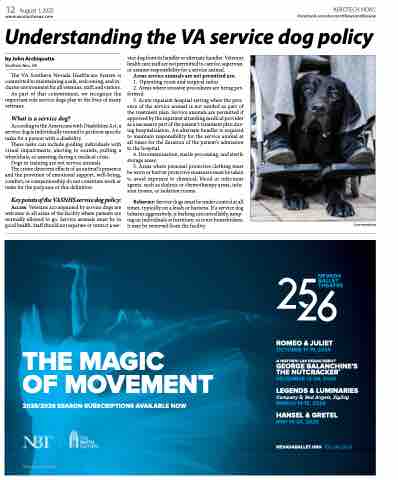
Courtesy photo
       THE MAGIC
ROMEO & JULIET
OCTOBER 17-19, 2025
OF MOVEMENT 2025/2026 SEASON SUBSCRIPTIONS AVAILABLE NOW
GEORGE BALANCHINE’S THE NUTCRACKER® DECEMBER 13-28, 2025
LEGENDS & LUMINARIES
Company B, Red Angels, ZigZag
MARCH 14-15, 2026
HANSEL & GRETEL
MAY 15-24, 2026
A HISTORIC LAS VEGAS DEBUT
 Photo by Virginia Trudeau.
NEVADABALLET.ORG 702.243.2623


