


Page 57 - July 2017
P. 57
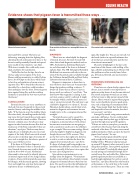
                                evidence shows that pigeon fever is transmitted three ways . . .
   Horse-to-horse contact.
dusty and blows around. The horses are defecating, stomping their feet fighting flies, churning the soil and manure into dust, so the bacteria could potentially flourish and spread more readily in that situation,” says Spier. With insect wounds, this could easily create ideal conditions for transmission.
“Stable flies feed on the legs, but also on the face and pectoral region of the chest. Horses with hypersensitivity to stable fly bites have a lot of bumps on the chest, which leads to hair loss and exudation of serum, attract- ing more flies. We’ve found these bacteria in the stable fly, so their bites could introduce these pathogens into the horse. Protecting your horse against biting flies and the resulting dermatitis is presently the best way to prevent the disease.”
CliniCal SignS
External abscesses can occur anywhere on the body, but most frequently in the pectoral muscles (breast) and along the midline of the belly. “If the bacteria enter the midline (where flies often feed), the swellings under the belly may move forward toward the pectoral region or back toward the sheath or udder. These are the most common areas, but abscesses may appear in other locations because flies feed on many areas of the body, especially if there are abrasions,” says Spier. The horse may have a single abscess or multiple abscesses in several regions of the body. Most horses with external abscesses do not develop signs of systemic ill- ness, such as weight loss, but about a quarter of these cases will have a fever.
If the horse is ill, further diagnosis is needed to determine if there is internal infec- tion. Internal abscesses may result in death
in about 30 to 40% of cases. Abdominal ultrasound is often useful to identify abscesses in internal organs such as liver, lungs, kidney, or spleen. A horse with internal abscesses may be lethargic, with decreased appetite, showing fever and weight loss, and may show signs of respiratory disease or abdominal pain.
From an infected horse to a susceptible horse via insects.
DiagnoSiS
“Blood tests are often helpful for diagnosis of internal abscesses, but must be used with other clinical and diagnostic methods such as CBC, biochemistry, abdominal fluid analy-
sis, and ultrasound of the chest or abdomen,” explains Spier. The SHI (Synergistic Hemolysis Inhibition) test measures antibody to the exo- toxin of this bacterium and is available through the California Animal Health and Food Safety Laboratory System in Davis, California.
Diagnosis is important to know how to treat the horse since there can be many other things that produce swelling or abscess. “I always tell clients that an abscess is just an abscess until you culture it,” says Slovis. “You don’t know what organism is causing it; you can’t just assume, until it’s cultured. It might be strangles (which could be much more seri- ous) or a puncture wound. The only way to get a definitive diagnosis is to culture it,” he says. Horsemen should always consult their veteri- narian for diagnosis and treatment because
it might prove to be a contagious disease like strangles.
“Internal abscesses can be caused by a variety of bacteria, and it’s challenging to try
to diagnose an internal abscess with cultures because most veterinarians are not going to stick a needle into an abscess in the abdomen to get a sample! There are some serology (blood tests) that might be helpful in diagnosis even though they are not 100% accurate. They
are the best tool we have right now, however,
to rule in or rule out whether the horse has
a pigeon fever internal abscess,” says Slovis.
If a horse is lethargic and losing weight, one possibility that should be considered is internal abscess, especially if the horse is in a region that has seen cases of pigeon fever.
Spier advises veterinarians not to use serology alone for diagnosis. “Veterinarians should not just submit a blood sample to make a diagnosis of internal abscesses based on titer alone. You need to see the other inflammatory changes in the bloodwork and other clinical
Via contact with contaminated soil.
signs, like weight loss. You can see titers all over the board (such as in exposed herdmates that do not have an actual infection) and the titer alone doesn’t mean much.”
Ulcerative lymphangitis is the least com- mon form of this disease, with swelling of the legs, cellulitis and draining tracts. Horses with this problem are often severely lame, lethar- gic, off feed and feverish, and need extensive treatment.
Prevention/Controlling an outbreak
If one horse on a farm develops pigeon fever abscess, insect control is very important to make sure other horses do not become infected. Fly control and proper wound care are some
of the best ways to help prevent spread of this disease. Horse owners in regions where pigeon fever occurs should also practice good sanita- tion, such as disposing of contaminated bed- ding. “Some people think they should isolate and hospitalize a horse for months, but that’s not necessary,” says Spier.
Strategic fly control, using various methods, can make a difference. Tactics could include parasitic wasps that lay their eggs in fly larvae and feed-through insect growth regulators.
“If there are cattle on your place, you need to control horn flies because they feed along the underside of the horse. This may cause ventral midline dermatitis, which can open the way for pigeon fever bacteria,” she says.
“A fly control program should be started early enough in the season to prevent a large buildup of flies. Whenever temperatures get
up around 70 degrees is when you need to start using these products. Insect growth regulators (such as SolitudeTM) are helpful when started in early spring and continued through fall to control house flies and stable flies. Other insect growth regulator products are available as a feed-through supplement for cattle to control horn flies,” says Spier. Horn flies only breed in cattle manure, so the cattle have to be treated in order to control these pests. There are some
SPEEDHORSE, July 2017 55
 equine health


