


Page 13 - IAV Digital Magazine #630
P. 13
iAV - Antelope Valley Digital Magazine
Scientists Find “Time Travel” Trick To Unlock Lost Childhood Memories
https://www.youtube.com/shorts/y6zGzF2l-xc
In a groundbreaking study, neuroscientists have discovered a simple yet ingenious "time travel" tech- nique that could help adults access long- forgotten childhood memories. By using a digital illusion to make participants feel like they're embodying their childlike selves, researchers unlocked richer recollections
from early life— potentially bypassing the fog of "childhood amnesia."
The research, led by Dr. Utkarsh Gupta and Professor Jane Aspell at Anglia Ruskin University's Self & Body Lab in Cambridge, UK, involved 50 healthy adult participants. Half of them viewed a
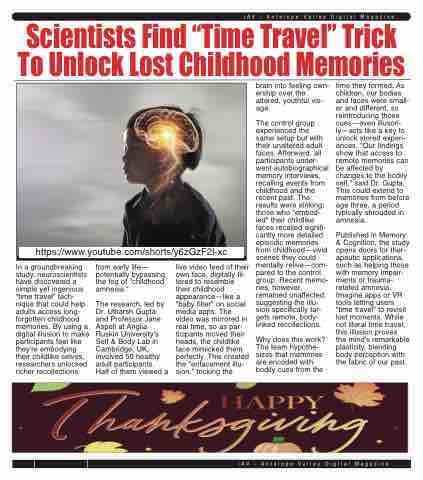
live video feed of their own face, digitally fil- tered to resemble their childhood appearance—like a "baby filter" on social media apps. The video was mirrored in real time, so as par- ticipants moved their heads, the childlike face mimicked them perfectly. This created the "enfacement illu- sion," tricking the
brain into feeling own- ership over the altered, youthful vis- age.
The control group experienced the same setup but with their unaltered adult faces. Afterward, all participants under- went autobiographical memory interviews, recalling events from childhood and the recent past. The results were striking: those who "embod- ied" their childlike faces recalled signifi- cantly more detailed episodic memories from childhood—vivid scenes they could mentally relive—com- pared to the control group. Recent memo- ries, however, remained unaffected, suggesting the illu- sion specifically tar- gets remote, body- linked recollections.
Why does this work? The team hypothe- sizes that memories are encoded with bodily cues from the
time they formed. As children, our bodies and faces were small- er and different, so reintroducing those cues—even illusori- ly—acts like a key to unlock stored experi- ences. "Our findings show that access to remote memories can be affected by changes to the bodily self," said Dr. Gupta. This could extend to memories from before age three, a period typically shrouded in amnesia.
Published in Memory & Cognition, the study opens doors for ther- apeutic applications, such as helping those with memory impair- ments or trauma- related amnesia. Imagine apps or VR tools letting users "time travel" to revisit lost moments. While not literal time travel, this illusion proves the mind's remarkable plasticity, blending body perception with the fabric of our past.
iAV - Antelope Valley Digital Magazine


