


Page 17 - Caribbean Reef Life Demo
P. 17
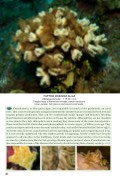
TUFTED OKEANIA ALGA (Okeania plumata) < 15 cm / 6 in
 an led mass of  lamentous threads   in ish inside and brown outside. Can grow on and around coral heads.
Cyanobacteria, or blue-green algae, are responsible for much of the productivity on coral reefs. They convert nitrogen into inorganic nutrients like nitrates that are essential for both reef and seagrass primary production. They can live symbiotically inside sponges and tunicates, breaking down limestone and allowing the rest of the reef to use the calcium. Although they are not classi ed as true plants  they lack chloroplasts and a nucleus  they share many of the same characteristics. These were the  rst life-forms that used photosynthesis to create oxygen, 3.5 billion years ago. They remain an important food source for many animals today, such as the Striated Seahare  below right .
In recent years, however, cyanobacteria has been spreading too  uickly and overgrowing coral reefs. It is not yet fully understood why this sudden growth is happening, but the results have become apparent to all who dive in the Caribbean. Coral heads and even large patches of reef are being overrun by cyanobacteria like the fast-growing Okeania species pictured above. Cyanobacteria are also responsible for some of the diseases that actively attack the living  esh of many corals  p. 102 .
40


