


Page 25 - Caribbean Reef Life Demo
P. 25
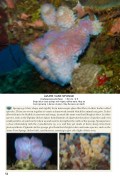
AZURE VASE SPONGE (Callyspongia plicifera) < 60 cm / 2 ft
 ri ht  lue  ase s on e  ith hi hl  ruf ed  alls.  a   e found  ro in  in dense clusters.  a   uoresce at de th.
Sponges get their shape and rigidity from microscopic glass-like  bers in their bodies called spicules. These are woven together to create a framework around which the animal can grow. It also allows them to be  exible in currents and surge, in much the same way that  berglass does. In other species, such as the Dysidea  below right , thin  laments of algae take the place of spicules and even small particles of sand can be taken up and used to strengthen the walls of the sponge. Sponges have a close relationship with the cyanobacteria  p. 40 , and they get much of their energy from their photosynthesis.  igments in the sponge give them their bright colors and some species, such as the Azure  ase Sponge  below left , can  uoresce, seeming to give off a light of their own.
58


