


Page 8 - VariofitEN
P. 8
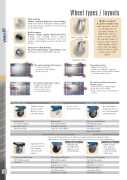
Pneumatic wheel Polyamide wheel
Suitable for uneven ground, e.g. with differences in level, especially outdoors.
For use on level ground in wet areas.
Solid-rubber wheel
Recommended for heavy loads even on poor ground and with sensitive payloads.
- Roller bearing - Roller bearing
- low carrying capacity - high carrying capacity
- Deep-groove ball bearing
- high carrying capacity
- good ride comfort - resistant to chemicals
- low noise
- abrasion-resistant (salts, fats, acids, alkalies)
- low rolling resistance
- high wear-resistance
Electrostatic discharge wheels (ESD) Polyurethane wheels
- high carrying capacity - high carrying capacity
For use in the industrial sector with heavy loads and for mixed indoor/outdoor applications. Polyurethanes can be selected specifically for your field of application.
96° Shore
92° Shore
Suitable where there is a need to prevent static charging
of the trolley and payload.
Particularly suita- ble in high-friction situations, e.g. for motorised trolleys.
Suitable for high- stress situations on rough ground, e.g. thresholds and outdoor areas.
- Deep-groove ball bearing - Deep-groove ball bearing
- Deep-groove ball bearing
- high carrying capacity
- low noise - low noise
- low noise
- high abrasion resistance
- high abrasion resistance
- high cut resistance
- high cut resistance
- low rolling resistance
- low rolling resistance
- high wear resistance
- high wear resistance
Wheel types / layouts
Plain bearing:
Simple, largely maintenance-free bearing. Impact-resistant. Polyamide bushing. Suitable for operation in wet conditions. For low-speed trucks and trolleys.
Roller bearing:
Robust, sturdy, largely maintenance-free bearing. Low bearing friction. Impact- resistant. Permanent lubrication. The most widely used bearing for low-speed trucks and trolleys.
Deep-groove ball bearing:
Precision ball bearing, easy-running, even with heavy loads and at higher speeds.
Two swivel and two fixed castors
- Commonest layout
- good directional stability - good cornering
One swivel and two fixed castors
- Suitable for light loads - highly manoeuvrable
- tends to tip if load
concentrated at front
Swivel castors with top plates,
bolt-hole castors
What is a castor?
A castor consists of at least one wheel, a fixed or swivelling fork, an axle and a means of attachment (e.g. to a truck or trolley). There are four basic types of castors. Swivel castors with top plates, fixed castors with top plates, bolt-hole castors, and swivel castors with spigot.
Four swivel castors
- Highly manoeuvrable,
suitable for cramped conditions
- improved directional stability thanks to lockable swivel castors
Two swivel and two fixed rollers, rhombic layout
- Fixed castors are slightly higher - good directional stability
- tends to tip if load concentrated at corners
8


