


Page 16 - statbility for masters and mates
P. 16
4 Ship Stability for Masters and Mates
Fig. 1.5
force of 5 N away from the point as shown in Figure 1.5. In this way both of the forces act either towards or away from the point. The magnitude and direction of the resultant is the same whichever substitution is made; i.e. 5.83 N at an angle of 59  to the vertical.
(c) Resolving two forces which act in parallel directions
When two forces act in parallel directions, their combined effect can be represented by one force whose magnitude is equal to the algebraic sum of the two component forces, and which will act through a point about which their moments are equal.
The following two examples may help to make this clear.
Example 1
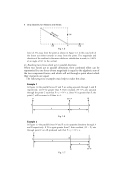
In Figure 1.6 the parallel forces W and P are acting upwards through A and B respectively. Let W be greater than P. Their resultant, (W   P), acts upwards through the point C such that P y W x. Since W is greater than P, the point C will be nearer to B than to A.
Fig. 1.6
Example 2
In Figure 1.7 the parallel forces W and P act in opposite directions through A and B respectively. If W is again greater than P, their resultant, (W   P), acts through point C on AB produced such that P y W x.
Fig. 1.7


