


Page 305 - statbility for masters and mates
P. 305
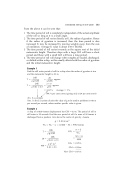
From the above it can be seen that:
1 The time period of roll is completely independent of the actual amplitude of the roll so long as it is a small angle.
2 The time period of roll varies directly as K, the radius of gyration. Hence if the radius of gyration is increased, then the time period is also increased. K may be increased by moving weights away from the axis of oscillation. Average K value is about 0:35  Br.Mld.
3 The time period of roll varies inversely as the square root of the initial metacentric height. Therefore ships with a large GM will have a short period and those with a small GM will have a long period.
4 The time period of roll will change when weights are loaded, discharged, or shifted within a ship, as this usually affects both the radius of gyration and the initial metacentric height.
Example 1
Find the still water period of roll for a ship when the radius of gyration is 6 m and the metacentric height is 0.5 m.
2pK
T   p             gEGM
9:81   0:5 0:5
  16:97 s. Average   17 s.
(99.71 per cent correct giving only 0.29 per cent error!!)
Ans. T 17:02s
Note. In the S.I. system of units the value of g to be used in problems is 9.81 m per second per second, unless another speci®c value is given.
Example 2
A ship of 10 000 tonnes displacement has GM   0.5 m. The period of roll in still water is 20 seconds. Find the new period of roll if a mass of 50 tonnes is discharged from a position 14 m above the centre of gravity. Assume
g   9:81 m/sec2
W2  W0 w 10000 50 9950tonnes
2K
  p           approx.
Unresisted rolling in still water 293
2pK 2 6
T   p                       p       approx.
GMT
2pK
T   p             gEGM
2pK
20   p                     9:81   0:5
400  4Ep2EK2 9:81   0:5
GG
GG1 GM New GM
 w d
1
W
  50   14
2 9950
 0:07m   0:50 m   0:57 m
ä
ä
ä


