


Page 364 - statbility for masters and mates
P. 364
352 Ship Stability for Masters and Mates
The following approximations are then used:
Mean Weight Moment  MW    WF   WA
2
This moment is calculated using the full particulars of the ship in its loaded condition.
Mean Buoyancy Moment  MB    W2   Mean LCB of fore and aft bodies
An analysis of a large number of ships has shown that the Mean LCB of the fore and aft bodies for a trim not exceeding 0.01 L can be found using the formula:
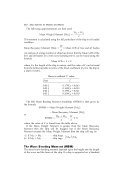
Mean LCB   L   C
where L is the length of the ship in metres, and the value of C can be found from the following table in terms of the block coef®cient (Cb) for the ship at a draft of 0.06 L.
Draft
0.06 L 0.05 L 0.04 L 0.03 L
C
0.179Cb   0.063 0.189Cb   0.052 0.199Cb   0.041 0.209Cb   0.030
Murray's coef®cient `C' values
The Still Water Bending Moment Amidships (SWBM) is then given by the formula:
or
SWBM   Mean Weight Moment  MW
  Mean Buoyancy Moment  MB
SWBM WF  WA  WELEC 22
where the value of C is found from the table above.
If the Mean Weight Moment is greater than the Mean Buoyancy
Moment then the ship will be hogged, but if the Mean Buoyancy Moment exceeds the Mean Weight Moment then the ship will sag. So
(i) IfMW >MB         shiphogs. }MWE MB (ii) IfMB >MW         shipsags. E
The Wave Bending Moment (WBM)
The actual wave bending moment depends upon the height and the length of the wave and the beam of the ship. If a ship is supported on a Standard


