


Page 56 - statbility for masters and mates
P. 56
44 Ship Stability for Masters and Mates
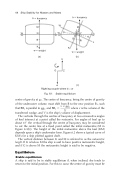
Righting couple where b   w Fig. 6.1. Stable equilibrium
centre of gravity at g1. The centre of buoyancy, being the centre of gravity
of the underwater volume, must shift from B to the new position B1, such
that BB1 is parallel to gg1, and BB1   v   gg1 where v is the volume of the V
transferred wedge, and V is the ship's volume of displacement.
The verticals through the centres of buoyancy at two consecutive angles of heel intersect at a point called the metacentre. For angles of heel up to about 15  the vertical through the centre of buoyancy may be considered to cut the centre line at a ®xed point called the initial metacentre (M in Figure 6.1(b)). The height of the initial metacentre above the keel (KM) depends upon a ship's underwater form. Figure 6.2 shows a typical curve of
KM's for a ship plotted against draft.
The vertical distance between G and M is referred to as the metacentric
height. If G is below M the ship is said to have positive metacentric height, and if G is above M the metacentric height is said to be negative.
Equilibrium
Stable equilibrium
A ship is said to be in stable equilibrium if, when inclined, she tends to return to the initial position. For this to occur the centre of gravity must be


