


Page 63 - statbility for masters and mates
P. 63
Effect of free surface of liquids on stability 51
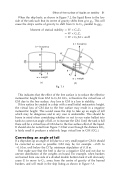
When the ship heels, as shown in Figure 7.2, the liquid ¯ows to the low side of the tank such that its centre of gravity shifts from g to g1. This will cause the ship's centre of gravity to shift from G to G1, parallel to gg1.
Moment of statical stability   W   G1Z1   W   GvZv
  W   GvM   sin y
Fig. 7.1
This indicates that the effect of the free surface is to reduce the effective metacentric height from GM to GvM. GGv is therefore the virtual loss of GM due to the free surface. Any loss in GM is a loss in stability.
If free surface be created in a ship with a small initial metacentric height, the virtual loss of GM due to the free surface may result in a negative metacentric height. This would cause the ship to take up an angle of loll which may be dangerous and in any case is undesirable. This should be borne in mind when considering whether or not to run water ballast into tanks to correct an angle of loll, or to increase the GM. Until the tank is full there will be a virtual loss of GM due to the free surface effect of the liquid. It should also be noted from Figure 7.2 that even though the distance GG1 is fairly small it produces a relatively large virtual loss in GM (GGv).
Correcting an angle of loll
If a ship takes up an angle of loll due to a very small negative GM it should be corrected as soon as possible. GM may be, for example  0:05 to  0:10 m, well below the D.Tp. minimum stipulation of 0.15 m.
First make sure that the heel is due to a negative GM and not due to uneven distribution of the weights on board. For example, when bunkers are burned from one side of a divided double bottom tank it will obviously cause G to move to G1, away from the centre of gravity of the burned bunkers, and will result in the ship listing as shown in Figure 7.3.


