


Page 20 - MENU Magazine - Sept/Oct 2017
P. 20
BACK OF HOUSE
Despite the changing landscape, what led to the demise of many retailers was their inability to provide quality (both real and perceived) at a reasonable price. Relative to their competitors, stores like Abercrom- bie & Fitch sold clothing that was over- priced for the quality. Sears tried to be all things to all people, and in the end, wasn’t great at anything.
COULD SOMETHING SIMILAR HAPPEN IN FOODSERVICE?
Canada’s restaurant industry has been
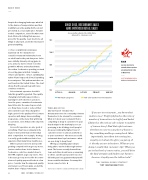
on a bull run for the past few years. Sales were initially driven by strong gains in 2012 and 2013 due to robust economic growth in Alberta and Saskatchewan. Since then, foodservice spending received a boost by gains in British Columbia, Ontario and Quebec. In fact, spending has taken o  and outpaced all retail spending in recent years. This pattern matches cur- rent trends in the United States. The chart shows that the spread in growth rates continues to widen.
Yet restaurant operators shouldn’t take this growth for granted. The rapidly changing retail landscape provides a warning for all foodservice operators. Over the years, a number of restaurants have fallen into the same trap as retail- ers. Many have closed or reduced their unit counts because they charged too high a price for the quality of food. Smart operators will always have something inexpensive on the menu that will bring in customers, even if that is the only item they buy.
Successful operators are also good at something. They have a uniquely niche brand or menu item that is better than their competition. For example, The Keg is a really good steakhouse that is less expensive than many fancy steakhouses.
Where operators need to worry is the growing competition from grocery stores. Just as retailers have lost to Amazon, foodservice could lose market share to the HMR segment at grocery stores. This is because grocery stores o er the conve- nience of quality prepared foods at a low price. Consider how the improved quality and low prices of frozen pizza eroded the market share of pizza restaurants.
20 MENU SEPTEMBER / OCTOBER 2017
(seasonally adjusted monthly data, indexed to January 2005)
180
162.5
145
127.5
110
DIG IN
Learn more about creating
sustainable business operations
and avoiding pitfalls by visiting
our Member Portal
______
VISIT THE MEMBER PORTAL
members.restaurantscanada.org
SINCE 2012, RESTAURANT SALES HAVE OUTPACED RETAIL SALES
OCT 2009
JAN 2012
OCT 2013
FEB 2015
MAY 2017
All Retail Categories
Full- and Quick-service Restaurants
THE LESSON FOR
RESTAURANT OPERATORS Restaurateurs need to constantly reinvent themselves to be relevant to consumers. What is it about your restaurant that is compelling to draw in customers? Is your brand unique in the marketplace or are you trying to be all things to all people? Are you providing the highest level of customer service to attract and hold on to your customers? The most successful restaurants have loyal customers—what are you doing to keep them?
O ering a compelling value is key to being able to survive in this tough environ- ment. The lessons recently learned from Sears and others should serve as a warning to others. Just because you were success- ful in the past is no guarantee that you will be successful in the future. For many, this lesson comes too late. m
Chart source: Statistics Canada and Restaurants Canada
“If you are in restaurants...you know what matters most. Traffic [defined as the ratio of number of transactions to traffic] and basket [defined as the ratio of sales volume to number of transactions]. Find that right customer.
Get them to come to your place of business, buy something and keep coming back. More importantly, turn them into raving fans... Loyalty isn’t about the offers you put up. It is the why you are in business. What are you doing to enable that customer’s life? When you get to that level of conversation...you will drive the kind of traffic and basket your business deserves. Loyalty must be told not sold.”
TONY CHAPMAN, BUSINESS STRATEGIST
TONY CHAPMAN REACTIONS


