


Page 36 - MENU Magazine - Sept/Oct 2017
P. 36
THE
EVOLUTION OF
THE BAR
Gone are the days that people are drinking just one spirit brand for life, and the proof is in the most recent resurgence of whisky—it has taken over as today’s trend-setting spirit of choice. And whisky is showing no signs of slowing down.
And it’s the old faithful cocktails such as the Old Fashioned and the Manhat- tan that have been perfect vehicles for exploring all the wonderful bourbons and ryes that have recently come out of the United States and Canada.
Whiskey distillers such as Koval in Chicago are pushing the envelop even further, making whiskey from very dif- ferent (and yes, more interesting) mash bills, using grains such as millet and oats, which is something the big boys from Kentucky have never brought to market. Now that’s innovation!
Even Scotland is seeing new craft
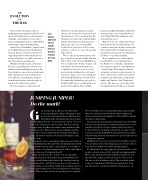
DON’T UNDERES- TIMATE THE VALUE OF SHARING PHOTOS OF BEAUTIFUL COCKTAILS VIA SOCIAL MEDIA
distilleries opening up shop, poising the age-old category to be upended and transformed so it too can keep up with the palate of today’s discerning whisky drinker who wants one thing and one thing only: choice. Scotch and Mil- lennial are now spoken of in the same sentence, so there are some interesting times ahead.
We’ve come a long way from the sub- par cocktails seen in the 1970s, 80s and 90s or what I call “10 years BC (10 years before cranberry).” Today’s young cock- tail drinker doesn't know what poor cocktails are. If you’re a 25-year-old professional working in the city, male or female, chances are you’re asking for a Bourbon Old Fashioned or gin-based Cucumber Basil Smash as opposed to a whisky with Coke or a vodka with soda. And even though the Harvey Wall-
bangers and Bahama Mamas had their times and places in cocktail history, I don’t think they’ll be making a come- back anytime soon.
Operators need to adapt on the bar as they do in the kitchen and failing to do so will not only leave dollars on the table; this would result in losing business by having the next generation of drinkers go elsewhere to get their drink  x.
Beer companies are embracing the trend with the recent popularity of the Radler—beer that has added fruit juice meant to make it somewhat more cocktailesque. We want more  avour, our palates are more re ned and we’re more educated as to what’s good. This is in uencing the manner in which we imbibe in Canada today. Traditional spirits—like gin—are especially trend- ing. Small and big brands are bringing
JUMPING JUNIPER!
Do the math!
G in, technically, is a  avoured vodka. Take neutral grain spirit, infuse with juniper and a selection of botanicals (generally based on
the liking of the distiller), and voila, you have gin. The Gin and Tonic—a tried and true classic—doesn’t have to be a Plain Jane on your menu. Put it in a proper bouquet glass, add  avour pairings using infusions and/ or herbs, some edible  owers; use a premium tonic like Fever Tree or the newly landed to Canada, Franklin & Sons...and you’ve turned a $7 standard drink into a $12 pro t centre.
It is about cost vs. contribution. Operators get stuck on cost thinking that a Gin and Tonic using infused gin with a premium tonic is going to carry a higher cost of 30 per cent or more on a $12 premium option, rather than 20 per cent or less on a $7 standard G and T.
What operators need to realize—the overall dollar amount going into the bank on a $12 premium Gin and Tonic is much higher than that of the standard options. It’s all about the contribution, not the cost. Consumers won’t drink less, they’ll just drink better and have better overall guest experiences even though they’re spending
more. They see value as they are getting a better-quality,
better-looking, better-tasting drink. Especially a drink that is social media-worthy (don’t underestimate the value of your guests sharing photos of beautiful cocktails through social media).
Restaurateurs, bar managers and owners need to think beyond conventional ideas and bravely innovate to boost margins. As with food items, menu engineering is key. Don’t just list the standard options that are expected by everyone. Instead, highlight the premium options, while still allowing o -menu standards to be poured and served to any guest, anytime.
Building out sections on your menu to include a variety of seasonal favourites like Sangria is a great way to direct your guest to drink better while adding margin!
Cocktail titles are super important as you need to catch people's attention; keep titles relatable and approachable. Give people what they want, but with your added touch through taste and presentation. It’s not rocket science.
If it was, we’d be building rockets. This is a fairly simple strategy to implement with but four ingredients: train- ing, know-how, creativity and a little elbow grease. m
36 MENU
SEPTEMBER / OCTOBER 2017


