


Page 133 - Bespoke Issue
P. 133
 fabrication methods, they had done the bodywork for the Auto Unions for Audi.
They used the “hammering” technique, so they actually hammered the bodywork over a wire frame as per original authentic speci cations of the day. So now when you open the panels up you can see all the little hammer marks.
When the cars would have been prepared for racing in period they would have coloured them, but they didn’t put an awful lot of paint on because paint was weight, likewise  ller, which they kept to a minimum also. So as you can see in the original pictures the cars are all cleanly presented and polished up nice, but when you have a really good look at the surface  nish of the car, there are ripples and bits and pieces in the surface: We have gone to the level of trying to replicate that  nish all over the cars as well so they are 1961 period correct.
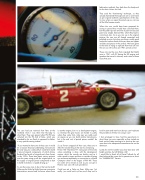
These cars are the ones that competed that fateful year in 1961, with 02 having the Hill engine and gearbox that raced in Monza, and a total of three races that year.
  The cars had just returned from Paris at the weekend when I was there that Thursday to shoot them. They were present when Phil Hill was inducted into the FIA hall of fame, which was attended by his son Derek to represent his father, a very special evening indeed.
“If you wanted to have one of these cars it would be a massive  nancial undertaking. To build one the only way you could justify it would be to build it around original components, of which Antony Bamford had a pile of original parts from Ferrari in the 1970s. There have been various projects over the years using up all the original parts, so the supply of original period components to start to build recreations is rapidly drying up.”
So are there any more to be or that can be built? Mike says he thinks he thinks there are some more transmissions around and he knows where there
is another engine, but it is a development engine, so whereas the gear boxes are harder to justify where they came from, mike says you really want an engine as you can build another transmission, but in the end cost of period pieces wouldn’t be worth it.
So as Ferrari scrapped all their cars, these are in effect the closest thing to the last two remaining Ferrari 156 “Sharknose” F1 racing cars in the world, unless something is done with the development engine, which the records are sketchy and as it never raced in anger and has no records of being run and more importantly no connection to a World Champion driver in the league of Phil Hill. These two seem set to remain as rare as you can get in Historic race cars with such providence.
Could you put a Value on them, Mike says “not really - you could work out how much they cost to
build in parts and man hours but you can’t replicate the providence of these two unique cars”.
I feel privileged to have had the opportunity to shoot these two cars, especially as they invited me back on the Friday morning to re shoot as the cars were due to be transported somewhere else on the afternoon.
Luckily for me the weather was clear blue skies with bright sunshine, but still bitterly cold!
I would like to thank all at Daniel Setfords for all their help and the owner for his permission to shoot his “SHARKNOSE” Ferraris.
133


