


Page 138 - Bespoke Issue
P. 138
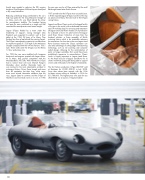
frontal area needed a reducion the XK’s engine height so Chief Engineer William Heynes developed a dry sump lubrication.
Reducing underbody drag contributed to the car’s high top speed for the long Mulsanne Straight at Le Mans, and a  n was  tted behind the driver for aerodynamic stability. The headrest fairing and aero  n were combined as a single unit that smoothed the aerodynamics and saved weight.
Jaguar D-Types  elded by a team under the leadership of Jaguar’s racing manager Lofty England were expected to perform well in their debut at the 1954 24 hours of Le Mans. They  nished less than a lap behind the winning Ferrari. The D-Type’s aerodynamic superiority is evident from its maximum speed of 172.8 mph on the Mulsanne Straight compared with the 4.9 litre Ferrari’s 160.1 mph. Three weeks later the D-Types won the Reims 12 hour endurance race.
For 1955 the cars were modi ed with Longnose bodywork and engines uprated with larger valves. At Le Mans, they proved competitive with the Mercedes-Benz 300 SLRs. Mike Hawthorn’s D-Type had a narrow lead over Juan Manuel Fangio’s Mercedes when another Mercedes team car was involved in the most catastrophic accident in motorsport history. Driver Pierre Levegh and more than 80 spectators lost their lives, while many more were injured. Mercedes withdrew from the race. Jaguar opted to continue and the D-Type of Hawthorn and Ivor Bueb went on to win. In 1956
the race was won by a D-Type entered by the small Edinburgh based team Ecurie Ecosse.
1957 proved to be the D-Types most successful year. 3.8 litre engined Jaguar D-Types took  ve of the top six places at Le Mans, the best result in the D-Types racing history.
Jaguar Land Rover Classic works is the largest facility of its type in the world, with a dedicated showroom and 54 workshop bays for servicing and restoration all Jaguar and Land Rover models out of production for a decade or more. It is also home to the Jaguar Land Rover Classic Collection of more than  ve hundred vehicles, a living assembly of British motoring history which is an invaluable reference for restorations. Its close ties to the core Jaguar Land Rover business means the Classic operation can also take advantage of cutting edge manufacturing technology, such as 3d scanning and computer aided design. Allowing for the reintroduction of parts no longer available, that would have been prohibitively expensive to remanufacture. Classic works is hugely important to Jaguar Land Rover, it’s the heart and soul of Jaguar Land Rover for its clients worldwide, being able being able to support owners and enthusiasts to the highest of standards.
The  rst factory production D-Type XKD-509 sold at Bonhams for £2,201,500.00 in July 2008. Since then values have soared; with the 1956 Le Mans winner selling at Sotheby’s in 2016 for $21,780,000. The highest price ever paid for any other British car at auction. A legend indeed.
  138


